
Reviewed · BELFAST BLACK TAXI TOURS
History of Belfast conflict and terror 1 hour black taxi tour
Belfast’s past is painted on its walls. This one-hour black taxi tour takes you through Republican and Loyalist districts, with a local driver-guide explaining the conflict, its people, and the uneasy peace that followed. I like the personal commentary and the chance to see places that are hard to understand from a map alone. I also like the tour’s compact route, which packs murals, memorials, the Peace Wall, and both sides of Belfast’s political divide into a single hour.
The main drawback is the short running time. Several stops last only a few minutes, so this is an introduction rather than a slow, detailed examination of every site. At $103.37 per person, the value depends heavily on the quality of your guide. One passenger singled out Brian for his moving, informed commentary, though a pickup problem caused an initial delay.
In This Review
- Key points at a glance
- Why a black taxi is a useful way to see Belfast
- Beginning with Bobby Sands and Republican Belfast
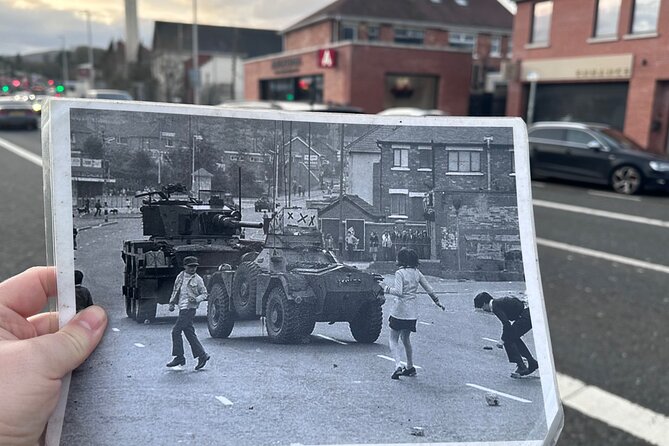
- Divis Flats and a city under military watch
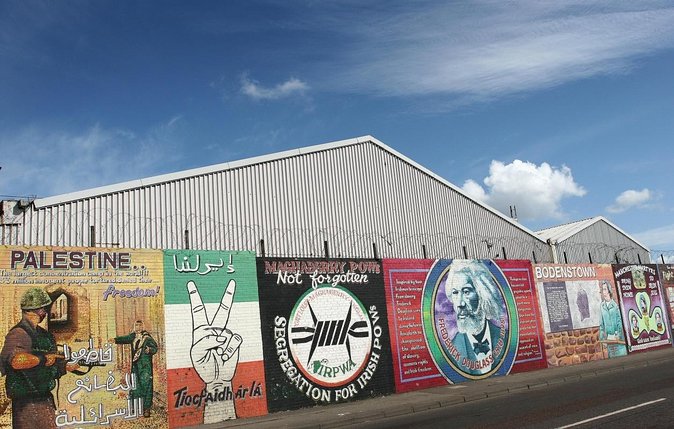
- International Mural Wall on Divis Street
- Returning to the Bobby Sands mural and the roots of the PIRA
- Clonard Monastery and the road toward peace
- The Peace Wall and Belfast’s unfinished peace
- Shankill Road and the Loyalist point of view
- What the one-hour schedule really feels like
- Price, pickup, and practical value
- Who should book this Belfast tour?
- Should you book it?
- FAQ
- How long does the Belfast black taxi tour last?
- Where does the tour start?
- Can I arrange pickup near Belfast City Hall?
- Does the tour pick up passengers directly from cruise ships?
- What language is the tour offered in?
- What places are included?
- Can I cancel for a full refund?
Key points at a glance
- Personal stories from The Troubles: Your driver-guide has lived through the conflict and explains how it affected daily life.
- Two sides of Belfast: The route covers Republican sites around Falls Road and Loyalist sites along Shankill Road.
- Peace Wall photo stop: You get time to see the barrier, read messages of peace, and take photographs.
- Black taxi setting: The cab provides a direct way to move through several neighborhoods without arranging separate transport.
- Clonard Monastery connection: This quiet religious site is linked to secret peace talks between Gerry Adams and John Hume.
- City-center pickup: Pickup is available within one kilometer of Belfast City Hall, but not directly from cruise ships.
Why a black taxi is a useful way to see Belfast
Belfast’s conflict was tied closely to streets, neighborhoods, churches, factories, housing blocks, and walls. A standard city sightseeing ride can show you the main buildings, but it may not explain why one mural faces another or why a barrier cuts through an urban community.
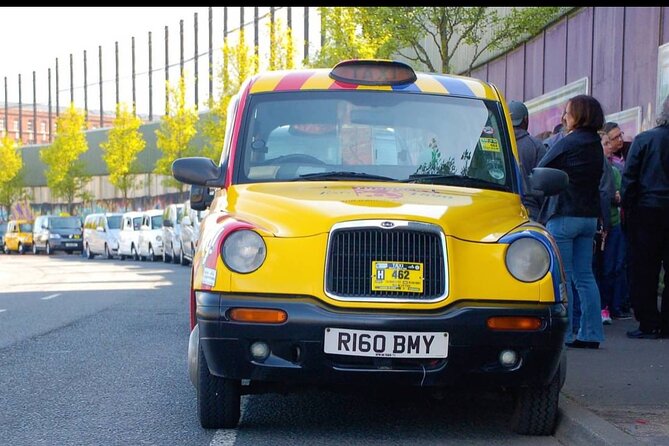
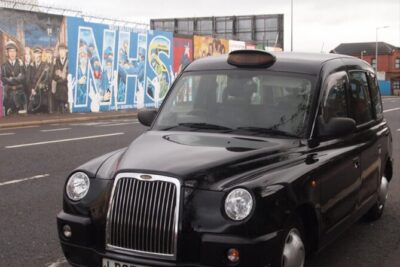
A black taxi gives you a moving history lesson in the places where that history happened. You travel from the Republican heartland around Falls Road and Divis to the Loyalist center of Shankill Road. The change is not presented as an abstract political debate. You see the murals, memorial gardens, flags, and defensive walls in their own neighborhoods.
The guide is central to the experience. The driver has lived through The Troubles and presents the Republican, Loyalist, and British perspectives before explaining the events as he understands them. That personal link is the tour’s greatest strength, but it also means the tone can vary from one driver to another.
I would approach this as a conversation, not a classroom lecture. Listen carefully, ask respectful questions, and remember that the same event can carry very different meanings in Belfast.
More black taxi tours in Belfast:
- Cab Tours Belfast Famous Black Taxi Tours
★ 5.0 · 3,633 reviews - Private Black Taxi Belfast City Tour
★ 5.0 · 2,188 reviews - Belfast’s Political Mural Taxi Tour
★ 5.0 · 1,180 reviews
Beginning with Bobby Sands and Republican Belfast
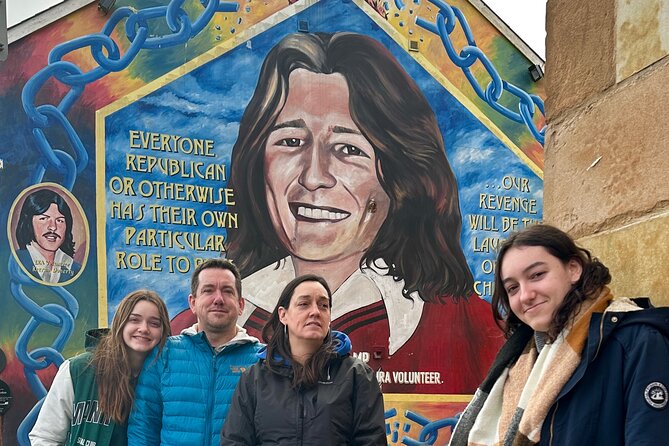
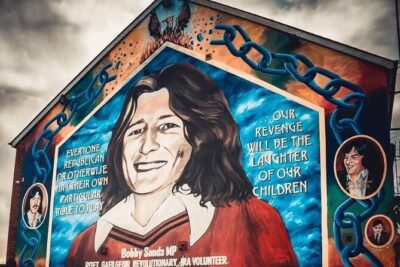
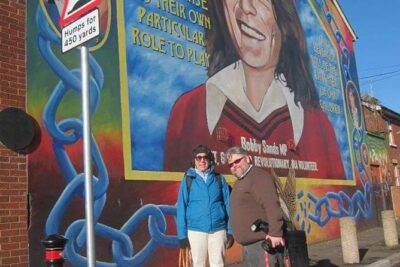
The first stop focuses on the Bobby Sands mural, a famous image associated with the Republican community. You also see murals and memorial gardens in the center of Republican Belfast.
Bobby Sands was an imprisoned Irish Republican Army member who died during the 1981 hunger strike. His mural has become one of Belfast’s best-known political images, and it helps explain why murals here are more than decoration. They act as memorials, political statements, and records of identity.
The guide also places the conflict in a much longer story of Irish resistance to British rule. The tour description refers to 800 years of revolutions, a broad historical frame that helps explain why local politics cannot be separated from questions of nationality, religion, and rule.
You have about ten minutes here. That is enough to look closely, take photographs, and hear the basic story, but not enough for a long examination of every mural. If you want a detailed study of Republican imagery, you would need more time elsewhere.
Divis Flats and a city under military watch
The short stop at Divis Flats gives you a glimpse of how closely military control once shaped ordinary life. The top two floors of the highest block were used as a British Army base for more than 25 years. Helicopters delivered supplies to troops there each day.
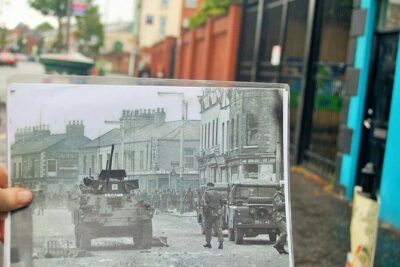
This detail makes the conflict feel physical. The issue was not only speeches, elections, and street murals. Soldiers, helicopters, checkpoints, and surveillance were part of the setting in which local residents lived.
You get roughly five minutes at Divis. The visit is mainly about the guide’s explanation, since the stop is brief. I would not expect a long exploration of the flats or a visit inside the former base. Still, it is a useful pause between the memorial sites and the larger wall displays.
International Mural Wall on Divis Street
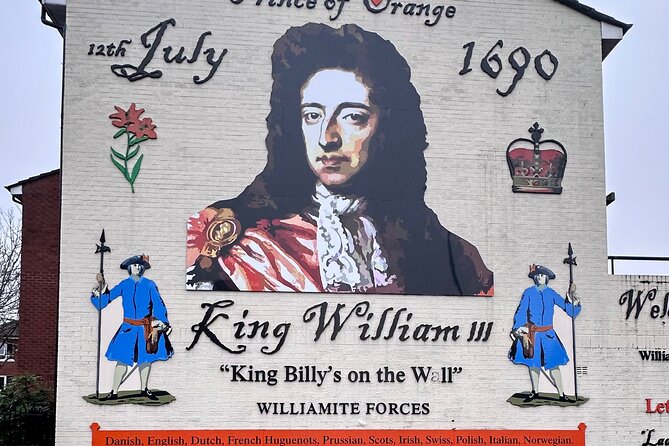
The International Mural Wall shifts the focus from local politics to causes around the world. More than 40 murals refer to struggles involving people in places such as Cuba, Palestine, and Kurdistan.
The wall shows how Belfast’s political art connects local identity with international causes. It also makes clear that murals have served as a way to show solidarity with people who, in the artists’ view, received little attention from the international media.
You have around five minutes here, which works for a quick look at the major images. The amount of information can be overwhelming, especially if your guide names several countries and political movements in quick succession. I would use this stop to photograph the murals, then ask about one or two that interest you rather than trying to absorb all 40.
More political history tours in Belfast:
- A History of Terror – Belfast City Centre Walking Tour
★ 5.0 · 2,883 reviews - Belfast Troubles Tour: Walls and Bridges
★ 5.0 · 853 reviews - Famous 1.5 hour Belfast Murals Tour
★ 5.0 · 477 reviews - Belfast Political Tour-Conflicting Stories Walking Tour
★ 4.5 · 459 reviews
Returning to the Bobby Sands mural and the roots of the PIRA
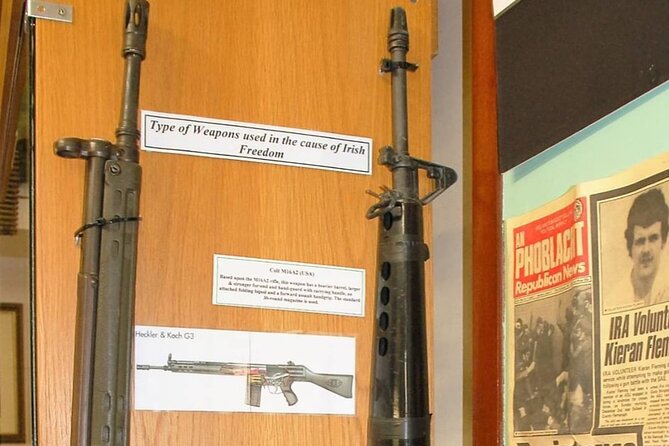
The itinerary includes another short stop at the Bobby Sands mural and describes the area as the birthplace of the Provisional Irish Republican Army. The repeated reference may reflect a second angle on the same area rather than a completely different site, so you should expect some overlap with the opening stop.
This part of the route links the mural to the history of the PIRA and to earlier Irish revolutions. The guide explains how the Republican movement viewed British rule and why armed resistance gained support in some communities.
The subject is difficult and politically charged. A good guide should help you understand the beliefs behind the movement without reducing the story to simple heroes and villains. The tour’s stated aim is to present several versions of the past, then offer the guide’s account of what happened. That approach can be useful, but it also calls for an open mind and thoughtful questions.
Clonard Monastery and the road toward peace
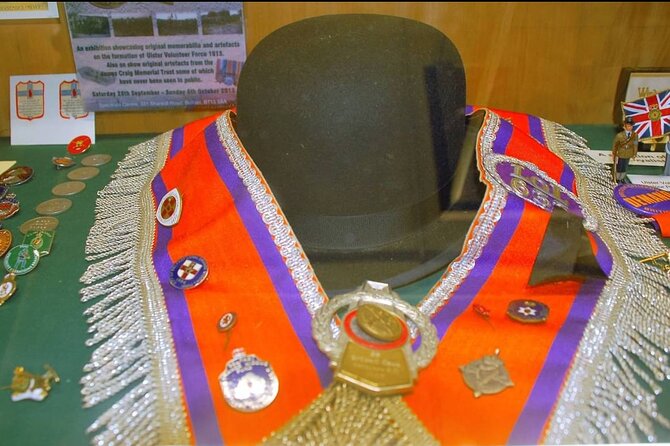
Clonard Monastery is a very different stop. Built more than 100 years ago by local and Italian craftsmen, it is described as a striking building and a place with an important role in the peace process.
The monastery hosted secret talks involving Gerry Adams and John Hume, with Father Alex Reid helping create a channel for communication. Those talks were part of the long effort to move from violence toward a political settlement.
You have only about two minutes here. That is not enough to study the architecture in depth, and the stop may feel rushed after the heavier political material. Its value comes from the connection between a quiet religious setting and private efforts to end the conflict. It reminds you that peace was built through discreet conversations as well as public agreements.
The Peace Wall and Belfast’s unfinished peace
The Peace Wall is the tour’s most visual stop. Belfast’s peace walls were built to separate Catholic and Protestant communities, and many sections have remained in place for more than 50 years.
The word peace can sound reassuring, but these are also barriers. They were built because communities feared one another and because violence had made ordinary contact dangerous. Their presence shows that the end of open conflict did not instantly erase fear or division.
The wall carries messages of peace from around the world. Names connected with those messages include President Clinton, Lady Gaga, and Morgan Freeman. You get about 13 minutes here, enough time to read some of the writing and take pictures.
This is likely the most powerful photo stop, but I would avoid treating it as a backdrop alone. Look at the height and length of the barrier. Notice how a structure meant to separate communities has also become a place where people write about reconciliation.
The tour does not suggest that Belfast’s divisions have vanished. That is an important distinction. A visit here is most useful when you see the wall as both a sign of progress and a reminder that peace can remain fragile.
Shankill Road and the Loyalist point of view
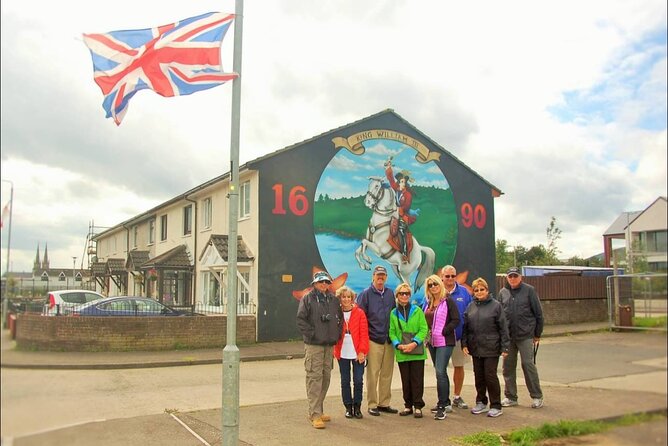
The final major stop is Shankill Road, described as the birthplace and center of the UDA and UVF. These Loyalist groups supported Northern Ireland remaining part of the United Kingdom, and the murals in the area tell that story through loyalty to the British crown, military memory, and local identity.
After hearing the Republican account, this part of the route provides a needed counterpoint. You see how the same decades of conflict were understood on the other side of the divide. The driver explains centuries of British rule in Ireland and the beliefs of people who identify as Loyalist.
The stop lasts about 20 minutes, making it the longest pause on the route. That gives you more time for photographs and questions. It also means the tour ends with a substantial look at the other community rather than treating it as a quick add-on.
I appreciate that the route includes both Falls Road and Shankill Road. A tour that only visits one side could leave you with a partial and distorted picture. Even with both districts included, one hour cannot cover every political detail, so think of Shankill as an essential introduction rather than a complete account.
What the one-hour schedule really feels like
The listed stops add up to about 60 minutes, with most of the time divided between short photo stops and commentary from the driver. The black taxi keeps the route moving, but you will not have much time to wander on foot.
That format suits you if you want a focused overview during a short stay in Belfast. It also works well as a first look before deciding which areas deserve a longer visit. If you prefer museums, long walks, or quiet time with memorials, the schedule may feel too tight.
The order of the route gives the experience a clear shape: Republican Belfast, military presence, international political art, peace efforts, the dividing wall, and Loyalist Belfast. The story moves from conflict and identity toward peace, without pretending that all divisions are gone.
The strongest part is the driver’s voice. One passenger had Brian as the guide and described his commentary as extremely moving and informative. The same account noted a pickup problem at the beginning, but the company resolved it and Brian collected the passenger. I would confirm your pickup before setting out, especially if your schedule is tight.
Price, pickup, and practical value
The cost is $103.37 per person. That is a high price for a one-hour tour if you judge it only by duration. You are not paying for admission tickets, since the stops are free. You are paying for a private-style vehicle experience, local interpretation, and access to several politically important areas in a short period.
The price makes more sense if you have limited time or do not want to work out the route yourself. A taxi takes you directly between neighborhoods, while the driver gives context as you go. For someone interested in modern Irish history, that combination can be worth more than a general sightseeing ride.
Pickup is offered at the Leonardo Hotel Belfast on Great Victoria Street, and free pickup is available within one kilometer of Belfast City Hall. The operator can collect you at the front gates of City Hall if you arrange it in advance.
Cruise passengers need to plan carefully. Direct pickup from the cruise ship is not offered because the port is several miles outside central Belfast. The cruise shuttle bus stops outside Visit Belfast, across from City Hall, so the stated meeting option is to get off there and arrange pickup at City Hall’s front gates.
Confirmation is provided at booking. Service animals are allowed, the tour is near public transportation, and most people can participate. Free cancellation is available up to 24 hours before the start time. Cancellations or changes made inside that period are not refunded or accepted, and the tour requires a minimum number of participants.
Who should book this Belfast tour?
I would recommend it to you if you want direct contact with Belfast’s recent past and prefer a local guide to a recorded audio tour. It suits first-time visitors, people with only a few hours in the city, and anyone who wants to compare Republican and Loyalist neighborhoods in one outing.
It is also a good choice if personal testimony matters to you. The guide’s experience of living through The Troubles can add emotional weight that a printed guidebook cannot provide.
I would hesitate if you want a neutral, academic presentation with extensive dates and documentation. The tour is built around a driver-guide’s spoken account, and the political subject is sensitive. You should be ready to hear strong opinions and ask questions with care.
Should you book it?
Book this tour if you want a fast, personal introduction to Belfast’s divided past, especially if the Peace Wall, murals, and local stories matter more to you than formal museum exhibits. The route covers both Republican and Loyalist areas, and the stop at Clonard Monastery adds an important link to the peace process.
Skip it if $103.37 feels too steep for one hour or if you want enough time to study each site at length. For the best value, arrange City Hall pickup in advance, confirm the meeting point, and treat the tour as a starting point for understanding Belfast rather than the final word on its history.
FAQ
How long does the Belfast black taxi tour last?
The tour lasts approximately one hour.
Where does the tour start?
The listed starting point is the Leonardo Hotel Belfast on Great Victoria Street, Belfast BT1 6DY.
Can I arrange pickup near Belfast City Hall?
Yes. Free pickup is available within one kilometer of Belfast City Hall, including the front gates by prior arrangement.
Does the tour pick up passengers directly from cruise ships?
No. Direct cruise ship pickup is not offered because the cruise port is several miles outside Belfast city center. The cruise shuttle bus stops near Visit Belfast, across from City Hall, where pickup can be arranged.
What language is the tour offered in?
The tour is offered in English.
What places are included?
The route includes the Bobby Sands mural area, Divis Flats, the International Mural Wall on Divis Street, Clonard Monastery, the Peace Wall, and Shankill Road.
Can I cancel for a full refund?
Yes. You can cancel for a full refund at least 24 hours before the experience begins. Cancellations or changes made less than 24 hours before the start time are not refunded or accepted.
More History Tours in Belfast
- Giants Causeway & Castles Tour from Belfast: Guided tour
★ 5.0 · 1,432 reviews - Giants Causeway, Rope Bridge, Carrickfergus Castle and Dark Hedges Tour
★ 4.0 · 596 reviews - Giant’s Causeway Tour from Belfast – Luxury Bus + Castles Tour
★ 4.5 · 372 reviews - From Belfast-Giants Causeway, Dunluce Castle and Dark Hedges tour
★ 4.5 · 193 reviews
Just added in Belfast
- Falls road Murals Walking Tour with former prisoners★ 5.0 · 19 reviews
- Private Half Day Winter Magic in the Antrim Glens★ 5.0 · 2 reviews
- Belfast’s Titanic Quarter: A Self-Guided Audio Tour★ 5.0 · 6 reviews
- The Troubles and iconic award winning taxi 2hr private cab tour★ 5.0 · 28 reviews
- Titanic Eastside Bike Tour★ 5.0 · 9 reviews
- The Single Cask Whiskey Experience★ 5.0 · 6 reviews
- Titanic Maritime Walking Tour★ 5.0 · 23 reviews
- The Hippy Bike Fully Enclosed Party Bike Tour (Individual Seats)★ 5.0 · 1 review
Belfast Black Taxi Tours, compared.

World Famous Belfast City Centre Black Cab/Taxi Tour 2 Hours
Read our review →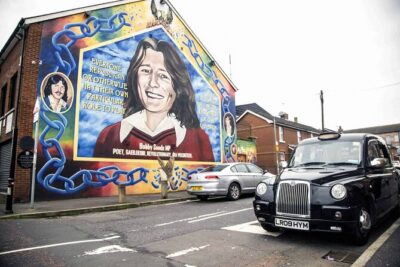
Black Taxi Tour and Crumlin Road Gaol tour Combo
Read our review →
Browse the lists this tour appears in