
Reviewed · BELFAST TROUBLES AND MURAL TOURS
Belfast Troubles Tour: Walls and Bridges
Belfast’s past is written on its walls. I like the local storytelling, especially when guides such as Arthur Magee and Steve connect political events to their own lives. I also like that the walk covers both the Troubles and the wider city, from City Hall and the Albert Clock to the Cathedral Quarter. The main drawback is the subject matter: graphic accounts and painful events make this unsuitable for children or anyone seeking a light sightseeing stroll.
You should also expect a fair amount of walking, with much of it outdoors. Still, the private format, small maximum group of 16, and personal attention give the tour a more thoughtful feel than a quick bus circuit. At about $33.29 per person for nearly three hours, it offers strong value if you want context rather than a checklist of sights.
In This Review
- Key points to know before you go
- Why this Belfast walking tour works
- Starting at City Hall: Belfast makes its first impression
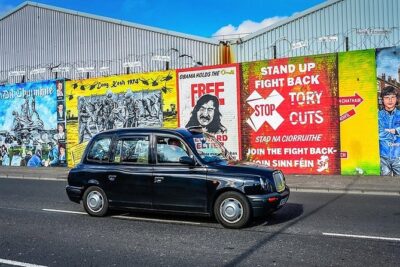
- Murals on Divis Street: politics painted large
- At the Peace Wall: the tour’s most powerful stop
- The Albert Clock: a leaning landmark with a film connection
- Cathedral Quarter and the Belfast Entries
- First Presbyterian Church: an unexpected ending
- The guide makes the difference
- How much walking and time to allow
- Is $33.29 a fair price?
- Who should book this Belfast tour?
- Should you book it?
- FAQ
- Where does the Belfast Troubles Tour begin?
- Where does the tour end?
- How long does the tour last?
- What language is the tour offered in?
- What is the minimum age?
- How many people can join the tour?
- Is the tour suitable for people with limited fitness?
- Can I cancel for a full refund?
Key points to know before you go
- Personal accounts from Belfast guides: Arthur Magee and Steve are praised for combining lived experience, humor, and clear explanations of the Troubles.
- The Peace Wall is the emotional center: You have time to look closely, take photographs, and hear why the barriers were built.
- It is not only a Troubles tour: City Hall, the Big Fish, the Albert Clock, Belfast Entries, and the Cathedral Quarter broaden the picture.
- The tone is serious but not grim throughout: Humor, music, politics, economics, and hopes for Belfast’s future all enter the story.
- Plan for almost three hours on foot: You need moderate physical fitness, comfortable shoes, and an open mind.
- Graphic material is included: The minimum age is 14, and the tour is not designed for young children.
Why this Belfast walking tour works
I like tours that help you understand a place before asking you to admire it. This one begins in central Belfast and gradually moves into the streets where the city’s political divide is most visible. You are not simply shown a wall and told that it represents conflict. You are given the setting, the language, the local geography, and the human cost behind it.
The title, Walls and Bridges, points to the central idea. The walls are physical barriers, such as the Peace Wall, but they also represent the lines people draw between communities. The bridges refer to the effort to build understanding across those lines.
That theme gives the walk a useful shape. You see grand civic buildings, old lanes, murals, churches, pubs, and political landmarks. The city becomes more than a backdrop for the Troubles. It becomes a place shaped by industry, religion, music, politics, family stories, and an uncertain but hopeful future.
The guides are a major part of the experience. Arthur Magee is often praised for his humor, directness, and personal connection to Belfast. Steve is also noted for sharing personal stories and making the past feel immediate. Their approach is not a detached lecture. It is a conversation led by someone who knows the city from the inside.
More political history tours in Belfast:
- A History of Terror – Belfast City Centre Walking Tour
★ 5.0 · 2,883 reviews - Belfast’s Political Mural Taxi Tour
★ 5.0 · 1,180 reviews - Famous 1.5 hour Belfast Murals Tour
★ 5.0 · 477 reviews
Starting at City Hall: Belfast makes its first impression
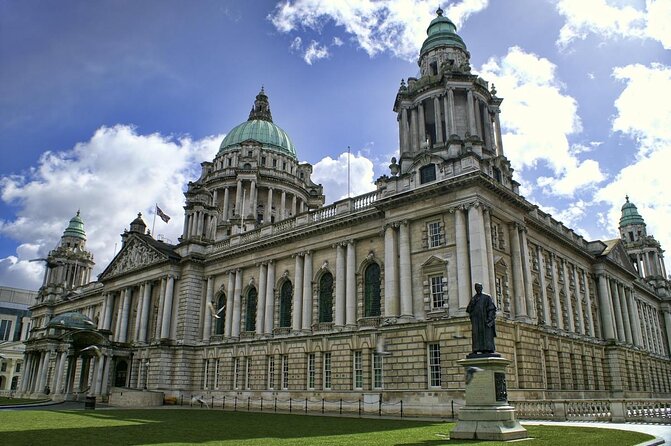
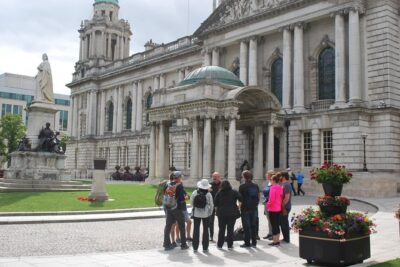
The tour begins at Belfast City Hall, one of the city’s grandest landmarks. You get a short introduction to the building, including its 174-foot dome, Italian marble, Greek Cippolino marble, and stained glass.
This is a smart starting point. City Hall represents civic confidence and the wealth created by Belfast’s industrial age. Its scale and decoration make an immediate statement, and the short stop lets you see that contrast before the tour turns toward the city’s harder stories.
You do not pay an admission fee for this stop. The visit is brief, about 10 minutes, so think of it as an orientation rather than a full interior tour. If you want a long look at the building or its displays, you may need to return on your own.
From here, the walk includes the Big Fish, a modern sculpture in the city center. Its Celtic design reflects Belfast’s engineering, industry, and communities. It is an easy sight to pass without much thought, but a good guide uses it to show how Belfast presents its identity today.
The Big Fish also helps keep the tour from becoming narrowly focused on violence. Belfast has difficult memories, but it is also a city of art, public spaces, work, and renewal.
Murals on Divis Street: politics painted large
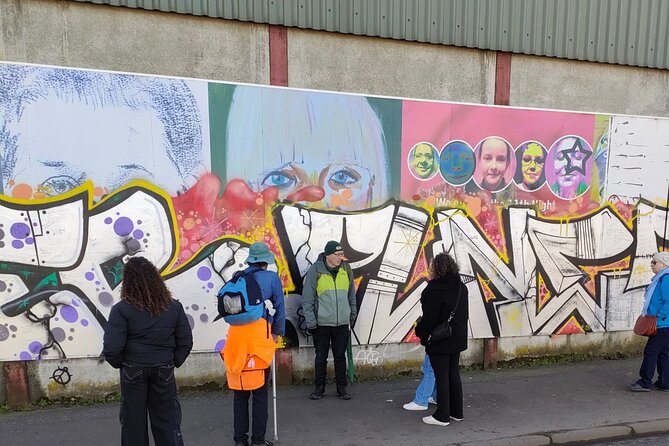
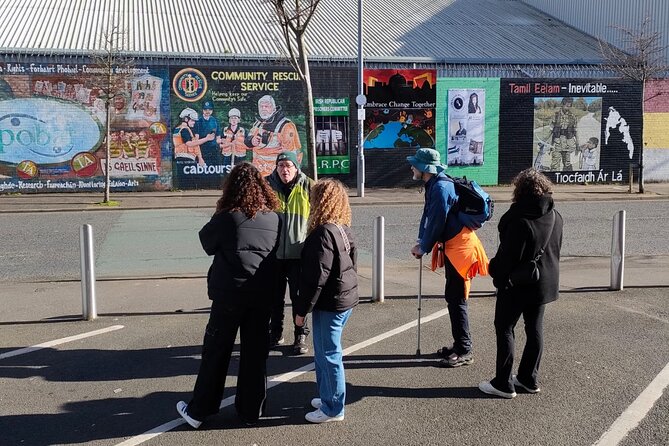
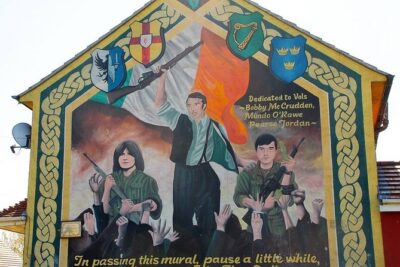
The International Mural Wall near Divis Street brings you closer to the political character of Belfast. Murals here function as public communication. They record causes, identities, international struggles, and local viewpoints.
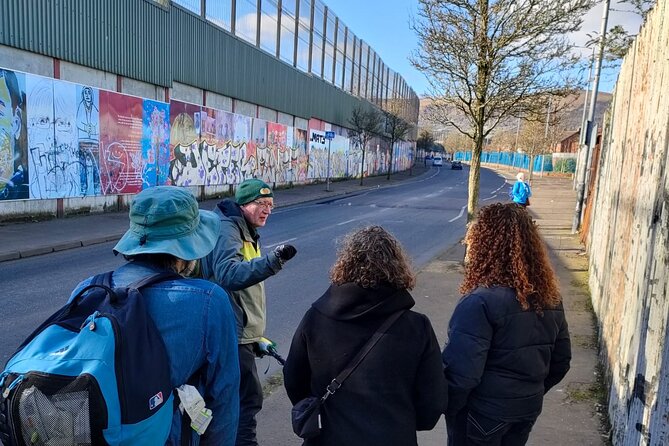
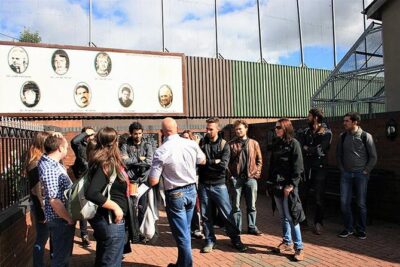
Expect explanation rather than a quick photo stop. The tour places these paintings near the Peace Walls, so you can begin to see how Belfast’s public art and physical divisions relate to one another.
This part can be challenging because murals are not neutral decoration. They reflect political positions and memories that may differ sharply from your own. The guide’s role matters here. Arthur is praised for offering a balanced account and for answering questions without reducing the conflict to a simple good side and bad side.
If you know little about Northern Ireland, the early historical context is especially useful. The story involves religion, politics, civil rights, British and Irish identities, discrimination, economics, and competing ideas about sovereignty. You will not learn every detail in three hours, but you should leave with a clearer framework for understanding what you see.
At the Peace Wall: the tour’s most powerful stop
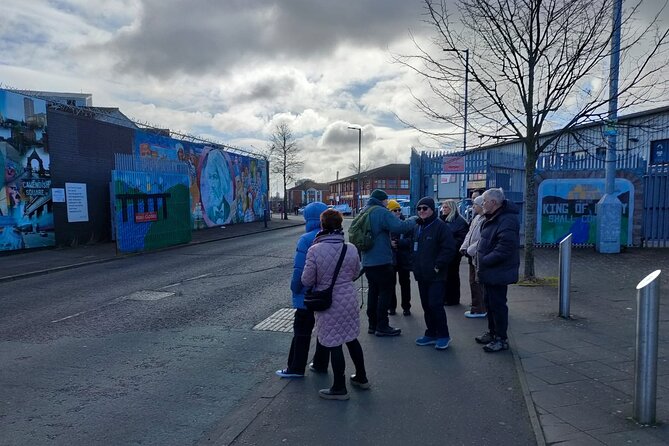
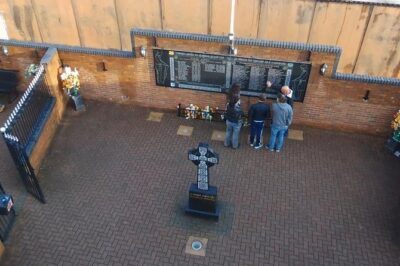
The Peace Wall is the point where the subject becomes physical. These barriers divide predominantly Unionist and Nationalist communities. They reach about 16 metres high and are topped with mesh designed to stop petrol bombs.
You have around 15 minutes to examine the wall and take photographs while the guide explains its purpose. That time matters. A hurried drive-by can make the wall seem like a strange urban curiosity. Standing beside it gives you time to consider what it means for a city to maintain such a barrier after the worst violence has eased.
This is also where the tour’s name becomes clear. A wall can protect people from immediate danger, but it can also preserve separation. The guide discusses both realities rather than presenting the structure as a simple symbol of failure or success.
The stories here can be graphic. Accounts of murder, injury, and daily fear are part of the tour’s purpose. If you prefer to avoid difficult material, this is not the right Belfast activity for you. If you are prepared to listen respectfully, the stop can provide a more honest understanding than a polished city tour.
Headsets may be provided, depending on the guide and group setup. That is useful when the group is spread along the wall or when city noise makes conversation difficult.
A completely different kind of day:
- From Belfast: Giant’s Causeway Full-Day Guided Trip
★ 4.8 · 6,361 reviews - Titanic Belfast Entrance Ticket: Titanic Visitor Experience Including SS Nomadic
★ 4.5 · 3,698 reviews - Cab Tours Belfast Famous Black Taxi Tours
★ 5.0 · 3,633 reviews - Game of Thrones and Giant’s Causeway Full-Day Tour from Belfast
★ 5.0 · 2,291 reviews
The Albert Clock: a leaning landmark with a film connection
Back in the city center, the Albert Memorial Clock adds a lighter architectural note. Belfast’s own leaning tower rises 113 feet and tilts about four feet from the perpendicular.
The clock stands near the spot associated with the crossing that helped establish Belfast. It also appeared in the film noir Odd Man Out, starring James Mason. You get only about five minutes here, so the stop is brief, but the clock makes a memorable photograph.
The building also reminds you that Belfast’s story is not confined to murals and barricades. Its historic center includes civic monuments, commercial streets, churches, and landmarks shaped by the city’s growth.
Cathedral Quarter and the Belfast Entries
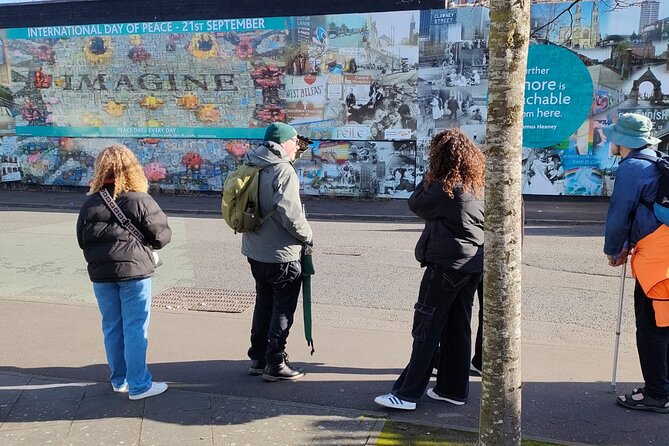
The Cathedral Quarter offers a change of mood. You walk among colorful murals, old entries, pubs, restaurants, and cobbled streets. The area is one of the newer social centers of Belfast, but its older lanes preserve a sense of the city’s past.
The tour also leads through Belfast’s historic entries, narrow passageways that are easy to miss unless someone points them out. These lanes connect the public city to smaller spaces associated with revolution, intrigue, and pub life.
I like this part because it makes the walking route feel local. You are not being moved from one famous landmark to another. You are threading through the city, seeing the places that give Belfast its texture.
The Cathedral Quarter also has links to important rock events. Music belongs in this tour because it helps explain Belfast as a living city, not only a place defined by conflict. The pubs and restaurants may tempt you to stop, but save that for after the walk so you can keep pace with the group.
First Presbyterian Church: an unexpected ending
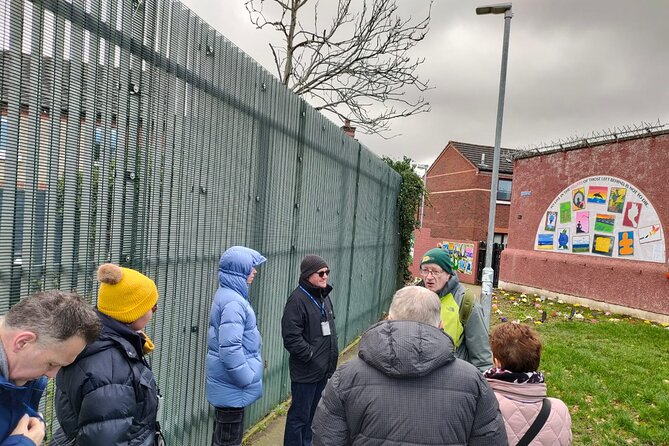
The final major stop is First Presbyterian Church on Rosemary Street, only about five minutes from City Hall. Dating from 1783, it offers a quiet ending after the intensity of the Peace Wall.
Inside, you can see an elliptical interior connected with John Wesley, who preached from the pulpit. The church’s story also complicates the usual account of Belfast as a city divided neatly along religious lines. Its members supported civil and religious freedoms, showing that the past included cooperation and disagreement within traditions as well as between them.
You have about 10 minutes to explore and take photographs. Admission is included. The church is a strong final stop because it shifts the discussion from division to the possibility of shared civic values.
The end point is at Rosemary Street, at First Presbyterian Church, within sight of City Hall. That makes the walk convenient for continuing into central Belfast after the tour.
The guide makes the difference
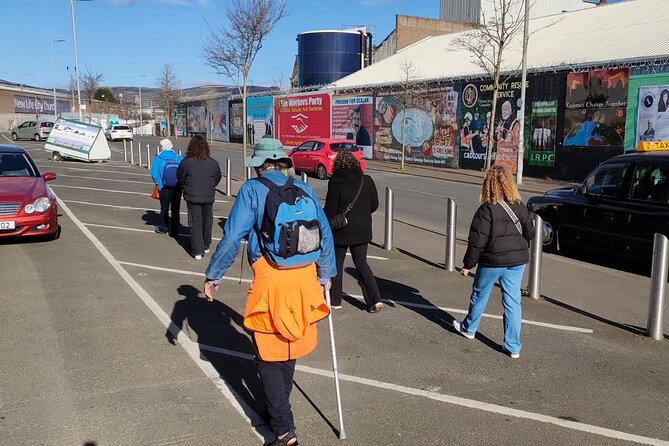
A three-hour walking tour lives or dies by its guide. Here, the strongest feature is the combination of information and personality.
Arthur Magee is repeatedly praised for his wit, directness, and storytelling. His personal experience gives the tour a human voice, while his willingness to discuss politics and prejudice keeps it from becoming a string of memorized facts. Steve is also praised for personal stories and clear explanations.
The best moments are likely to come when you ask questions. The guide can explain how a political event affected ordinary life, why a particular neighborhood carries certain symbols, or how Belfast is changing today.
The humor needs to be handled carefully. Used well, it gives you room to breathe during a painful subject. It does not erase the seriousness of the material. The tour’s strongest accounts describe a balance of humor, sadness, politics, music, economics, and hope.
Do not expect every question about Northern Ireland to be settled. The guide makes clear that no three-hour walk can cover every part of the conflict. That honesty is useful. You are getting an introduction with personal insight, not a university course.
How much walking and time to allow
The advertised duration is about two hours and 40 minutes to three hours, though one account describes a longer experience. The stated tour length is three hours, so allow at least that much time and avoid scheduling a tight connection afterward.
You need moderate physical fitness. The route includes city streets, entries, neighborhood areas, and outdoor stops. Comfortable footwear is sensible, and you should be ready to stand while listening.
The tour is offered in English only. It is a private tour with a maximum of 16 people, so your experience should feel more focused than a large group walk. Private does not necessarily mean one guide for one person or one couple. It means the booking is arranged as a private experience, with the stated maximum group size of 16.
The meeting point is Belfast City Hall, Belfast BT1 5GS. The walk ends at First Presbyterian Church on Rosemary Street, Belfast BT1 1QB. Both locations are near public transportation.
Service animals are allowed. The minimum age is 14, and the tour is specifically not aimed at children because of graphic content.
Is $33.29 a fair price?
At $33.29 per person, I consider this good value for a nearly three-hour private walking experience with a local professional guide. You are paying for interpretation and access to difficult context, not admission to expensive attractions. Most stops are free, while admission to First Presbyterian Church is included.
The price makes the most sense if you are interested in politics, social history, architecture, or local identity. You receive a broad introduction to central Belfast plus a close look at the Peace Wall and murals.
A short sightseeing walk would cost less in time and emotional energy. This tour asks more of you, but it also gives you more to think about. If you want only cheerful landmarks and pub recommendations, spend your money elsewhere.
The tour is often booked about 18 days ahead. That does not guarantee it will sell out every day, but it is a useful sign to reserve before your visit if your dates are fixed.
Who should book this Belfast tour?
I would choose this walk if you want to understand Belfast before exploring it on your own. It suits first-time visitors, people interested in the Troubles, students of conflict and civil rights, and anyone who values a local voice over a scripted sightseeing route.
It is also a good first activity in Belfast because it gives later visits more meaning. Afterward, murals, neighborhoods, churches, and public monuments will not feel like disconnected sights.
You should be comfortable hearing about violence and political conflict. The guide aims for balance, but balance does not mean softening the facts. Come ready to listen, ask fair questions, and accept that the city’s story remains complicated.
Free cancellation is available if you cancel at least 24 hours before the start time. Late cancellations are not refunded, and changes within 24 hours are not accepted. The experience also requires a minimum number of participants, so a cancellation by the operator may lead to another date, another experience, or a full refund.
Should you book it?
Book this tour if you want a serious, personal introduction to Belfast, especially if you would rather walk through the city than watch it from a bus. The Peace Wall, Divis Street murals, historic entries, and First Presbyterian Church create a varied route, while Arthur Magee or Steve can turn the past into something understandable and human.
Skip it if you are traveling with young children, dislike graphic material, or have only a short window for a relaxed city-center stroll. For everyone else, the combination of local stories, difficult facts, humor, and cautious hope makes this one of the strongest ways to begin understanding Belfast.
FAQ
Where does the Belfast Troubles Tour begin?
It begins at Belfast City Hall, Belfast BT1 5GS, UK.
Where does the tour end?
It ends at First Presbyterian Church on Rosemary Street, Belfast BT1 1QB, within sight of Belfast City Hall.
How long does the tour last?
The stated duration is approximately two hours and 40 minutes to three hours. You should allow about three hours.
What language is the tour offered in?
The tour is offered in English.
What is the minimum age?
The minimum age is 14. The tour is not aimed at children and includes graphic content.
How many people can join the tour?
The maximum group size is 16 travelers.
Is the tour suitable for people with limited fitness?
The tour requires a moderate level of physical fitness because it is a walking experience lasting close to three hours.
Can I cancel for a full refund?
Yes. You can cancel at least 24 hours before the start time for a full refund. Cancellations or changes made less than 24 hours before the experience are not accepted for a refund.
Just added in Belfast
- Falls road Murals Walking Tour with former prisoners★ 5.0 · 19 reviews
- Private Half Day Winter Magic in the Antrim Glens★ 5.0 · 2 reviews
- Belfast’s Titanic Quarter: A Self-Guided Audio Tour★ 5.0 · 6 reviews
- The Troubles and iconic award winning taxi 2hr private cab tour★ 5.0 · 28 reviews
- Titanic Eastside Bike Tour★ 5.0 · 9 reviews
- The Single Cask Whiskey Experience★ 5.0 · 6 reviews
- Titanic Maritime Walking Tour★ 5.0 · 23 reviews
- The Giants Causeway Tour★ 5.0 · 1 review
Belfast Troubles and Mural Tours, compared.
A History of Terror – Belfast City Centre Walking Tour
Read our review →
Belfast Political Tour-Conflicting Stories Walking Tour
Read our review →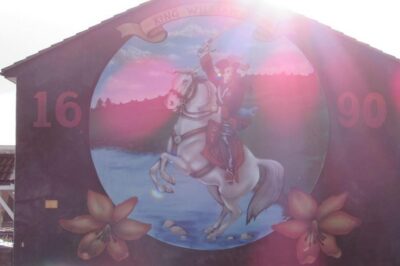
2 Hour Private Belfast Taxi Cab Tour of Troubles & Peace walls
Read our review →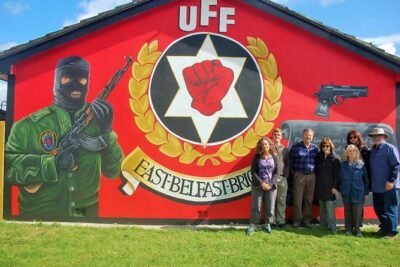
2 hours Belfast Original Drivers The Troubles Black Taxi Tour
Read our review →Browse the lists this tour appears in