
Reviewed · BELFAST BLACK TAXI TOURS
Official World Famous Belfast Taxi Tour ™
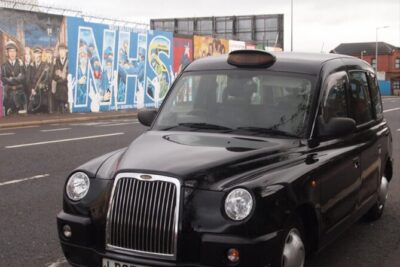
Belfast’s walls still speak. This private taxi tour makes the city’s divided past easier to understand, taking you from the Falls Road to the Shankill Road with a local guide at the wheel. I like the chance to step out beside the murals, and I like hearing firsthand stories from guides who grew up during the Troubles. The main drawback is its heavy subject matter, which may be too graphic or upsetting for young children.
The tour lasts about 90 minutes to two hours and costs $90.98 per person. I also appreciate the private format: your group travels in an air-conditioned vehicle, asks questions freely, and can often shape the pace. Just note that some pickup locations cost extra, and time at major sights can feel brief.
In This Review
- Key points to know before booking
- Why a taxi tour fits Belfast’s divided neighborhoods
- Starting at the Bobby Sands mural and International Wall
- The Peace Wall and Cupar Way
- Clonard Monastery and the Clonard memorials
- Crossing to the Shankill Road
- The Bayardo attack and the cost of sectarian violence
- St Peter’s Cathedral and Divis Street
- How the route handles the Troubles
- Private transport, pickup, and timing
- Is $90.98 good value?
- Who should take this tour?
- Final verdict: book it for context, not just photos
- FAQ
- How long does the Belfast Taxi Tour last?
- Where does the tour start?
- Is hotel pickup available?
- Is this a private tour?
- What areas and sights does the tour visit?
- Can I cancel for a full refund?
Key points to know before booking
- Personal stories from Belfast locals: Guides such as Paula, Barry, Billy, Joe, Neil, Chris, and Lorraine explain the Troubles through local experience as well as dates and events.
- Both sides of the divide: The route visits Catholic Republican areas around the Falls and Clonard, plus Protestant Loyalist areas around the Shankill.
- Murals you can see up close: You can leave the taxi for photos and view political art tied to Bobby Sands, William of Orange, the IRA, the UDA, and the UVF.
- A private, flexible ride: Only your group participates, with hotel or Airbnb pickup available in Belfast city centre when requested.
- A serious but useful history lesson: The tour deals with shootings, bombings, hunger strikes, memorial gardens, and continuing separation by Peace Walls.
- Book ahead: The experience is often reserved 36 days ahead, and it has a 4.9 rating from 623 reviews, with 98% recommending it.
Why a taxi tour fits Belfast’s divided neighborhoods
Belfast’s political story is not confined to a museum. It is painted on gable ends, marked by memorial gardens, and built into streets where Catholic and Protestant neighborhoods still sit close together. A taxi tour gives you a practical way to see these places without trying to work out the route yourself.
The private vehicle matters here. You can ask about a mural as you pass it, stop for a photo, or request more explanation about an event that catches your attention. The guides are Belfast locals, and several have described growing up during the Troubles. That personal connection is the strongest part of the experience.
I would not book this as a light sightseeing ride. The tour covers death, imprisonment, paramilitary groups, bomb attacks, hunger strikes, and the effects of violence on ordinary families. It can be funny at moments because the guides use local humor, but the central story is painful and serious.
The route is designed to show both communities rather than present only one political viewpoint. That balance is important. You will see Republican memorials and murals, then Loyalist murals and memorials, often within a short drive of each other.
More black taxi tours in Belfast:
- Cab Tours Belfast Famous Black Taxi Tours
★ 5.0 · 3,633 reviews - Private Black Taxi Belfast City Tour
★ 5.0 · 2,188 reviews - Belfast’s Political Mural Taxi Tour
★ 5.0 · 1,180 reviews
Starting at the Bobby Sands mural and International Wall
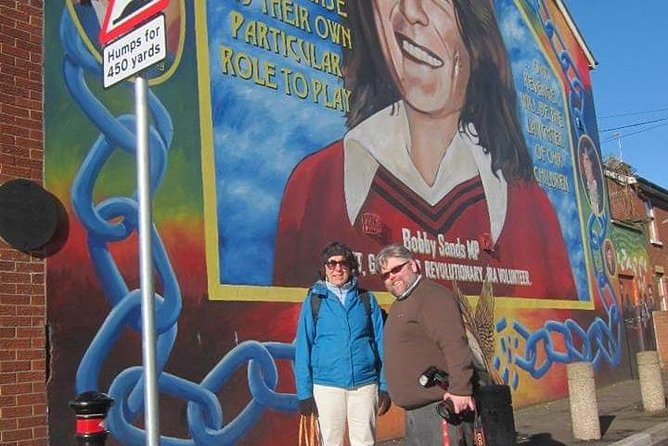
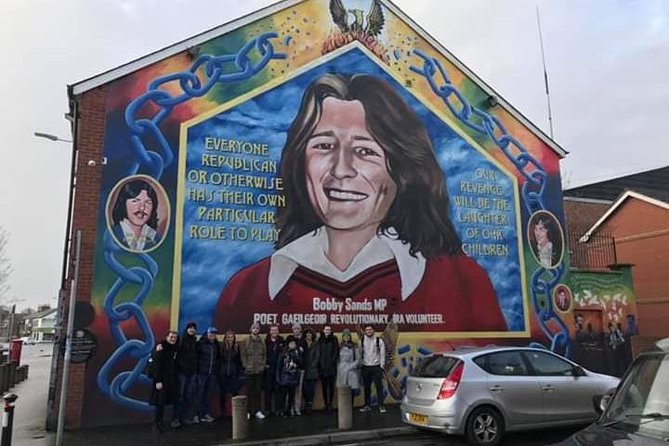
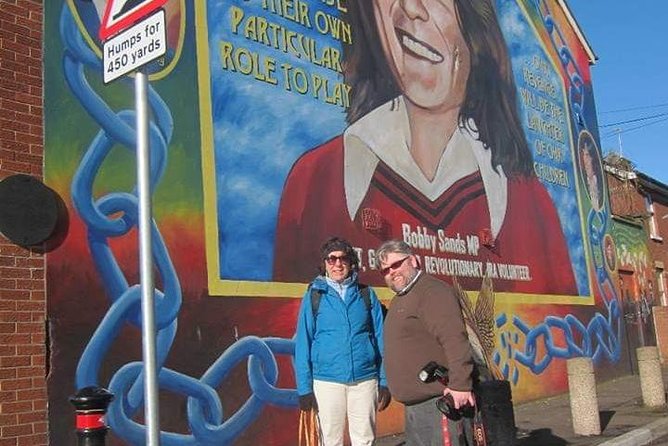
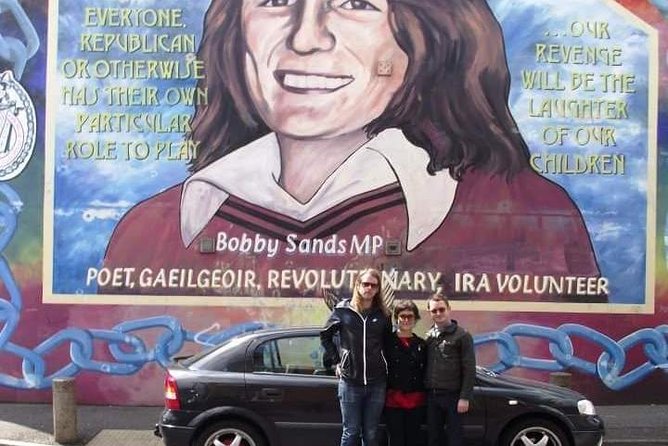
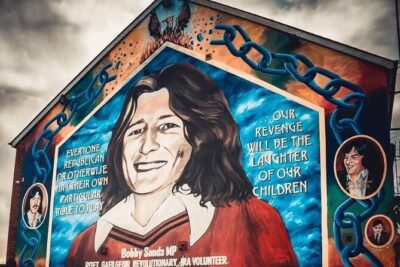
The tour commonly begins in the Republican area around the Falls Road and Divis Street. Bobby Sands is the most recognizable figure here. An IRA member and hunger strike leader, Sands died during the 1981 hunger strike while serving a prison sentence.
His image appears on one of Belfast’s best-known murals. The mural is not simply a photo stop. It opens a discussion about imprisonment, Republican identity, British rule, and the way political figures are remembered in public art.
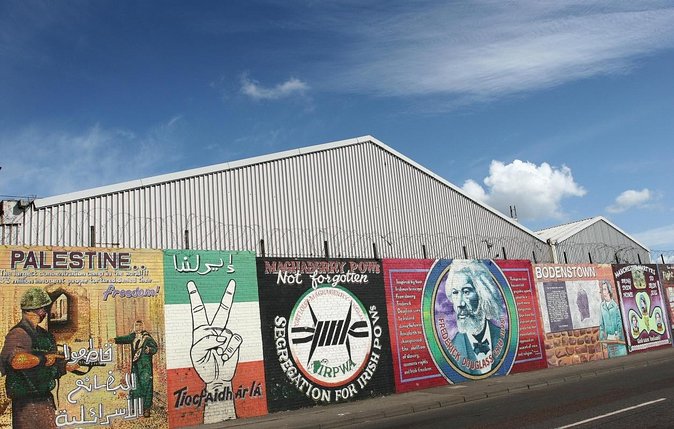
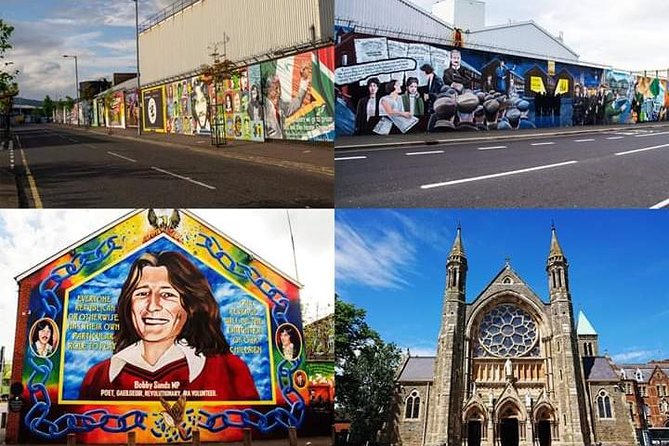
Nearby, the International Wall carries murals connected to Irish Republican causes and international struggles. Themes can include the 1981 hunger strike, the Ballymurphy Massacre, the McGurk’s Bar bombing, and solidarity with revolutionary movements abroad.
You can get out and take photos, but allow yourself time to look at the details. These paintings are political statements, not just colorful backdrops. Your guide can explain why particular symbols, names, and slogans matter.
The itinerary lists several Bobby Sands stops. That reflects the fact that his mural and the surrounding Republican art are central to this part of Belfast. The exact sequence may vary, so do not expect fourteen entirely separate attractions. Some stops are short pauses near related murals and memorials.
The Peace Wall and Cupar Way
The Peace Wall is one of the clearest physical reminders that the conflict has not vanished from daily life. These barriers separate predominantly Catholic Nationalist areas from predominantly Protestant Unionist areas. Some sections are made from brick, iron, or steel, and parts can reach about 25 feet high.
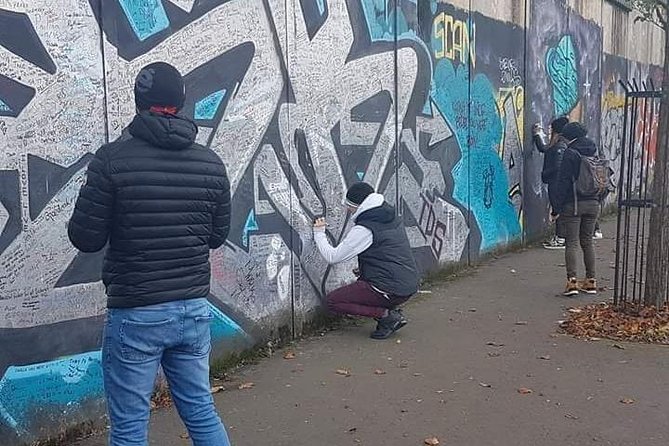
At the Cupar Way section, you can see the barrier up close and write your name or a message of hope on the wall. Bill Clinton and the Dalai Lama are among the notable people who have signed it.
This is one of the tour’s most memorable moments, but it can also feel rushed. The listed stop is about five to ten minutes, and one person who enjoyed the tour still wished for more time at the Peace Wall. If you want a long walk along the wall or extended photo time, ask your guide early in the ride.
The Peace Walls have gates, and some are closed at night. Their purpose was to limit violence between nearby communities. Seeing the wall in person helps you understand the gap between political agreements and everyday trust.
The tour does not pretend that the wall is merely a historic relic. You are shown a barrier that still divides parts of Belfast today. That makes this stop more than a photo opportunity.
Clonard Monastery and the Clonard memorials
Clonard Monastery sits near the interface between the Republican Falls area and the Loyalist Shankill area. Its position helps explain why this part of Belfast became so tense. The monastery is also a striking landmark amid the surrounding streets.
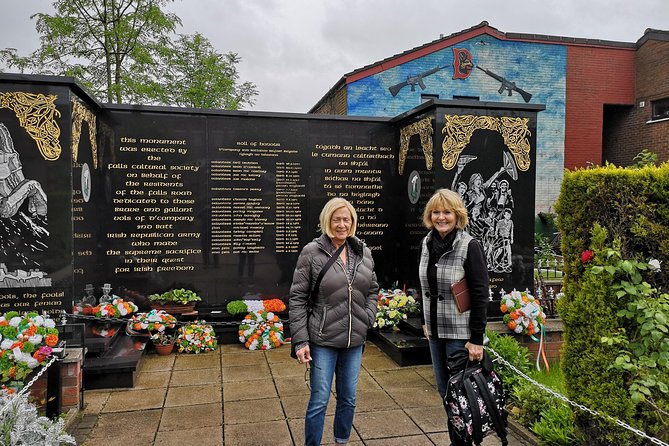
The tour includes the Clonard Martyrs Memorial Garden on Bombay Street. The garden remembers fallen volunteers from IRA C Company, civilian victims from the Greater Clonard area, and Republican prisoners who died between 1916 and 1970.
Memorial gardens can be difficult to read without local context. Names and plaques reflect how one community remembers its dead, and the guide explains the events and beliefs behind those memorials. The annual commemorative march around March 11 is also connected with the site.
I value this stop because it moves the story away from famous murals and toward individual loss. At the same time, the memorial is openly Republican in its focus. Your guide’s explanation is important if you want to understand the community’s view rather than mistake the garden for a neutral monument.
The route may include a second visit to the Clonard Martyrs Memorial Garden. Treat the repeated listing as extra time in the same area rather than a different attraction.
A completely different kind of day:
- From Belfast: Giant’s Causeway Full-Day Guided Trip
★ 4.8 · 6,361 reviews - Titanic Belfast Entrance Ticket: Titanic Visitor Experience Including SS Nomadic
★ 4.5 · 3,698 reviews - A History of Terror – Belfast City Centre Walking Tour
★ 5.0 · 2,883 reviews - Game of Thrones and Giant’s Causeway Full-Day Tour from Belfast
★ 5.0 · 2,291 reviews
Crossing to the Shankill Road
The move from the Falls and Clonard to the Shankill Road is central to the tour. Here, the murals reflect Loyalist and Unionist identity. You can see murals connected with the UDA and UVF, as well as traditional themes such as King William of Orange, the Battle of the Boyne, the Battle of the Somme, and the 36th Ulster Division.
King William, often called King Billy, is a familiar figure in Loyalist mural art. The imagery connects present-day political identity with events in British and Irish history.
The guide may also show armed Loyalist murals around Sherbrook Close and the Shankill Road Memorial Garden. These sites commemorate members of Loyalist groups and local victims. As with the Republican memorials, the displays are not detached museum pieces. They show how a community chose to honor its dead and explain its own past.
The Shankill section is a good test of the guide’s balance. You should hear about the Loyalist view without having the Republican side ignored. The strongest guides, including Paula and Barry, are praised for showing both sides and answering difficult questions directly.
The Bayardo attack and the cost of sectarian violence
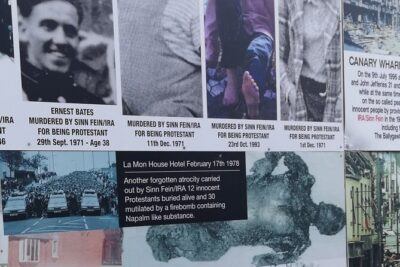
The tour visits the area connected with the Bayardo Bar attack of August 13, 1975. An IRA unit attacked the pub in the Loyalist Shankill area with a bomb and gunfire. The stated target was linked to the UVF, but four Protestant civilians and one UVF member were killed, and more than fifty people were injured.
This stop gives the Shankill route a specific human cost. It helps you understand that violence was not only about political leaders or armed groups. Pubs, homes, schools, and streets became places where civilians could be caught in the conflict.
The nearby memorial garden remembers those killed. You may find this part of the tour especially sobering because the guide connects the event to a real location rather than presenting it as a distant date in a textbook.
The tour also includes a chance to see examples of real plastic and rubber bullets used by British Crown forces. That physical detail can make the history more immediate, though it adds to the serious tone. If you are sensitive to depictions of violence, keep that in mind before booking.
St Peter’s Cathedral and Divis Street
St Peter’s Cathedral sits on Divis Street in the Falls area. Construction began in the 1860s, and it serves as the Roman Catholic cathedral for the Diocese of Down and Connor.
The cathedral provides a change of focus from murals and memorials. It reflects the religious and civic setting of the Catholic community and helps place the surrounding political art in a wider neighborhood context.
The tour also shows Divis Tower and the Welcome Wall. Divis Tower is associated with the Republican area, and the tour explains how a British Army sniper’s position once operated there. It is a reminder that the Troubles were fought and watched from ordinary urban buildings.
You may not spend long at the cathedral itself. This is primarily a driving and stopping tour about Belfast’s political history, not a church tour. Still, the building is a useful landmark as you move between the Falls Road sites.
How the route handles the Troubles
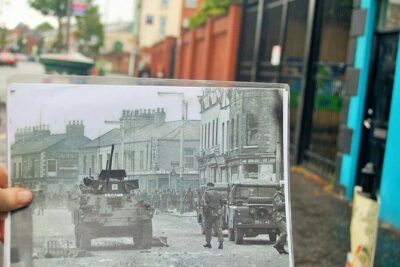
The tour’s main strength is its use of place. Instead of giving you a general lecture on Northern Ireland, it links events to walls, gardens, streets, pubs, and buildings.
You will hear about how the conflict began in 1969, the role of Republican and Loyalist paramilitary groups, the 1981 hunger strike, and the Good Friday Agreement. The guides also explain that peace did not erase every division. The continued presence of Peace Walls shows that the settlement remains a process rather than a neat ending.
Personal accounts add another layer. Paula is described as Belfast-born and as someone raising her own family in the city. Billy and Barry have spoken about growing up during the Troubles. Joe is praised for inviting questions, while Neil is noted for stopping wherever a question or photo opportunity called for it.
Those personal stories can be powerful, but they also mean the tone may differ from guide to guide. One guide might focus more on family memories, another on political detail, and another on humor. You can make the most of the format by asking what you want to understand before the tour starts.
Private transport, pickup, and timing
The standard meeting point is the Leonardo Hotel Belfast on Great Victoria Street. Free pickup and drop-off are offered there. Belfast city centre hotel or Airbnb pickup can be requested, but an extra charge may apply.
The vehicle is private and air-conditioned. Only your group takes part, which is useful for families, couples, and small groups who want to discuss sensitive topics without a larger audience.
The tour offers start times from 8 a.m. through 5 p.m. The advertised duration is about one hour and 30 minutes to two hours. Because several stops last only five or ten minutes, you should not expect a long walking tour at each site.
Cruise ship pickup costs £25, and returning to the ship costs another £25, paid directly to the guide. Pickup or drop-off at the Titanic Museum, Crumlin Road Gaol, or Lanyon Train Station costs an additional £10 in cash. Queen’s University, the Botanic Gardens, and the Ulster Museum also carry a £10 charge.
Those add-ons can change the value quickly. If you are staying in central Belfast, the basic price is easier to justify. If you are arriving by cruise ship, calculate the extra £50 for transport before booking.
There is also a VIP upgrade to a Mercedes-Benz V-Class for £20 when available. I would treat that as a comfort option, not a reason to choose the tour. The guide and the route matter far more than the vehicle model.
Is $90.98 good value?
At $90.98 per person, the tour is not the cheapest way to see Belfast’s murals. Its value comes from privacy, local storytelling, convenient transport, and the ability to see both sides of the divide in one compact outing.
For a group of several people, a private taxi can compare well with separate admissions, taxis, and self-guided transport. You also save time and avoid navigating streets where the historical significance is not always obvious.
The price is harder to defend if you want a slow photographic walk or a broad introduction to all of Belfast. The route concentrates on the Troubles and political murals. It does not replace visits to the Titanic Belfast museum, Crumlin Road Gaol, or other major city attractions.
I see it as a focused history tour. Book it early if it fits your plans, since it is commonly reserved about 36 days ahead. Group discounts are available, and the strong 4.9 rating from 623 ratings, along with a 98% recommendation rate, suggests that the format works well for its intended audience.
Who should take this tour?
I would recommend it to adults who want local context, families with older children, and anyone who finds public history more useful when connected to real streets. It is also a smart choice if you have only a short time in Belfast and want an efficient introduction to the city’s divided communities.
The tour suits you especially well if you:
- Want to ask direct questions about the Troubles
- Prefer private transport to a large coach
- Need hotel pickup in central Belfast
- Want photographs at murals and Peace Walls
- Are comfortable with difficult subjects and political memorials
- Want to hear personal memories from Belfast-born guides
I would think twice if you are seeking a cheerful city tour, dislike discussions of violence, or are traveling with very young children. One guide specifically warns that some displays are too graphic for children, and the subject matter is heavy throughout.
Free cancellation is available up to 24 hours before the start time. Changes or cancellations made less than 24 hours ahead are not accepted for a refund.
Final verdict: book it for context, not just photos
I recommend the Official World Famous Belfast Taxi Tour if you want to understand why Belfast’s murals and Peace Walls matter. The best part is not simply seeing Bobby Sands or King William painted on a wall. It is hearing how those images connect to memory, identity, fear, and daily life.
The tour earns its price through local guides, private transport, and access to both Republican and Loyalist neighborhoods. Paula, Barry, Billy, Joe, Neil, Chris, and Lorraine are all praised for warmth, humor, clear explanations, and a willingness to answer difficult questions.
Book it early, confirm your preferred start time, and check pickup fees before paying. If possible, tell your guide whether you want more history, more photography, or more personal stories. Choose this tour for a serious, direct look at Belfast’s recent past, then leave time elsewhere in your visit for the city’s museums, architecture, food, and present-day life.
FAQ
How long does the Belfast Taxi Tour last?
The tour lasts approximately one hour and 30 minutes to two hours.
Where does the tour start?
The standard meeting point is the Leonardo Hotel Belfast on Great Victoria Street, Belfast BT1 6DY.
Is hotel pickup available?
Yes. Free pickup and drop-off are offered at the Leonardo Hotel Belfast. Pickup and drop-off at Belfast city centre hotels or Airbnbs can be requested, but an extra charge may apply.
Is this a private tour?
Yes. Only your group participates, and the tour uses private, air-conditioned transportation.
What areas and sights does the tour visit?
The route includes Republican areas around the Falls Road, Divis Street, and Clonard, plus Loyalist areas around the Shankill Road. Stops include political murals, the Peace Walls, Clonard memorials, the Bayardo Memorial Garden, St Peter’s Cathedral, Cupar Way, and Divis Tower.
Can I cancel for a full refund?
You can cancel up to 24 hours before the experience start time for a full refund. Cancellations or changes made less than 24 hours before the start time are not accepted.
Just added in Belfast
- Falls road Murals Walking Tour with former prisoners★ 5.0 · 19 reviews
- Private Half Day Winter Magic in the Antrim Glens★ 5.0 · 2 reviews
- Belfast’s Titanic Quarter: A Self-Guided Audio Tour★ 5.0 · 6 reviews
- The Troubles and iconic award winning taxi 2hr private cab tour★ 5.0 · 28 reviews
- Titanic Eastside Bike Tour★ 5.0 · 9 reviews
- The Single Cask Whiskey Experience★ 5.0 · 6 reviews
- Titanic Maritime Walking Tour★ 5.0 · 23 reviews
- The Giants Causeway Tour★ 5.0 · 1 review
Belfast Black Taxi Tours, compared.

World Famous Belfast City Centre Black Cab/Taxi Tour 2 Hours
Read our review →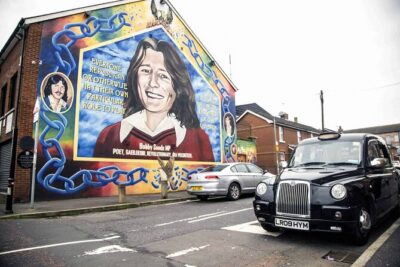
Black Taxi Tour and Crumlin Road Gaol tour Combo
Read our review →
Original Drivers Belfast Taxi/Cab Tour 2 hour private adventure
Read our review →Browse the lists this tour appears in