
Reviewed · BELFAST BLACK TAXI TOURS
Official World Famous Belfast Black Taxi Tour
Belfast’s walls tell hard stories. This private black taxi tour makes sense of them through murals, memorial gardens, old photographs, and local commentary, taking you between Republican and Loyalist districts without asking you to walk long stretches through unfamiliar streets. I like the direct access to places such as the Falls Road, Shankill Road, Divis, and the Peace Wall. I also like that guides such as Paula and Barry explain both sides of the conflict rather than presenting only one political view.
The main consideration is the pace. With roughly 10 minutes at many stops and a total duration of about 90 minutes to two hours, you will see a lot quickly. The price of $130.34 per person can also feel high for a short tour, though the private taxi, hotel pickup, and personal guide make it more worthwhile for a small group.
In This Review
- Key points to know before booking
- Why a black taxi is the right way to see Belfast’s divided streets
- Starting at Divis and the Falls Road
- The International Wall and murals from around the world
- Seeing the Peace Wall up close
- Crossing to Shankill Road and Loyalist Belfast
- Memorial gardens and the names behind the murals
- Bobby Sands, Sinn Féin, and the Falls Road
- The final mural stops on Sherbrook Close
- What the guides add to the experience
- Price, pickup, and timing
- Who should book this Belfast taxi tour?
- Should you book it?
- FAQ
- How long does the Belfast Black Taxi Tour last?
- How much does the tour cost?
- Is the tour private?
- Is hotel pickup included?
- Is cruise port pickup included?
- What language is the tour offered in?
- Can I be dropped at Titanic Belfast or Crumlin Road Gaol?
- Can I cancel for a full refund?
Key points to know before booking
- The tour crosses both sides of Belfast: You visit Republican Falls Road and Divis, then Loyalist Shankill Road and its memorials.
- The Peace Wall is not just a photo stop: Your guide explains why these barriers were built and how they still shape daily life.
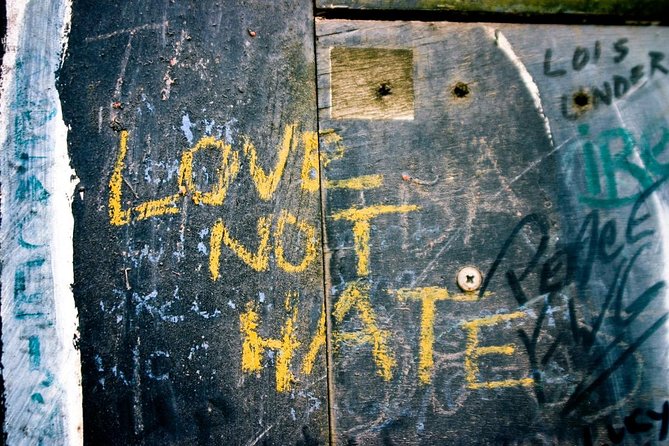
- Former prisoners painted many of the murals: The artwork covers civil rights, hunger strikes, international causes, prison protests, and community identity.
- Local guides are central to the experience: Paula is praised for her warmth and clear explanations, while Barry receives strong marks for the breadth of his historical detail.
- You can request free central Belfast pickup: Hotel and Airbnb pickup and drop-off are included when arranged in advance.
- Some transport extras cost more: Cruise port pickup is $20 each way in cash, and drop-off at Titanic Belfast or Crumlin Road Gaol costs an extra $10.
Why a black taxi is the right way to see Belfast’s divided streets
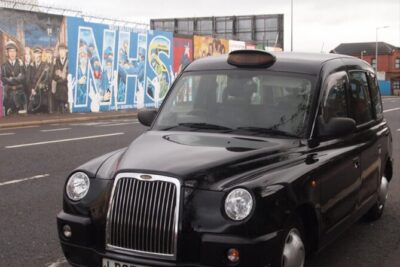
Belfast’s political murals are spread across several neighborhoods. Walking from the Falls Road to the Shankill Road would take time, and the route crosses areas with powerful symbols, flags, memorials, and barriers. A private black taxi gives you a contained setting and lets the guide focus on the story instead of directions.
You ride with your own group rather than joining a large shared party. The booking allows up to 18 people, so the value improves if you are traveling with family or friends. For a couple, the per-person cost is harder to justify, but the private format still gives you room to ask questions and stop for photographs at the guide’s pace.
The taxi matters for another reason. This is not a tour built around grand buildings or formal museums. Much of what you see is in ordinary residential streets, where murals sit beside houses and memorials occupy small corners of the neighborhood. The vehicle helps you cover that ground while keeping the commentary close and personal.
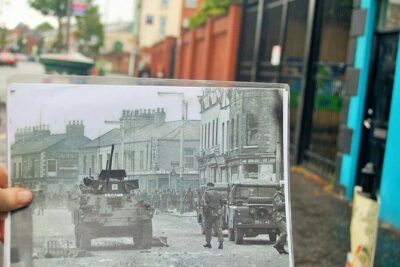
Your guide uses photographs and videos from the 1970s onward to connect present-day streets with events from the Troubles. That visual comparison can be especially useful because the modern street may look calm while the older images show barricades, soldiers, protests, and destruction.
More black taxi tours in Belfast:
- Cab Tours Belfast Famous Black Taxi Tours
★ 5.0 · 3,633 reviews - Private Black Taxi Belfast City Tour
★ 5.0 · 2,188 reviews - Belfast’s Political Mural Taxi Tour
★ 5.0 · 1,180 reviews
Starting at Divis and the Falls Road
The first stop is the Welcome Wall at the start of the Falls Road, the center of Republican West Belfast. This is an important introduction because the Falls is not simply a street lined with political art. It is a place where Irish republican identity, local memory, and the long campaign for Irish freedom are displayed in public.
The guide explains the murals as individual stories. Some deal with civil rights and community struggle. Others refer to prison protests, political beliefs, or events that shaped the neighborhood. The tour describes several of these works as painted by former prisoners from both sides of the conflict, giving the art a personal connection to the period.
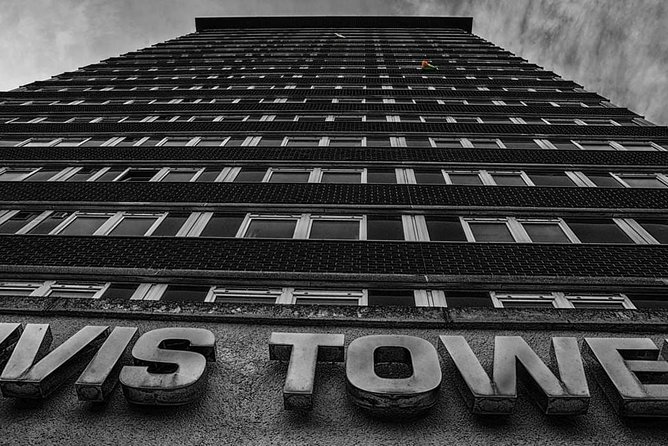
You also see Divis Tower, a familiar landmark that was used by the British Army as an observation post and sniper position during the Troubles. That detail helps explain why a building that might otherwise look like a standard tower block became a symbol of surveillance and military presence.
The stop lasts about 10 minutes. That is enough to hear the opening explanation and take photos, but not enough for an extended look at every mural. If you want to study the artwork closely, keep your camera ready and listen for the guide’s suggestions about what matters most.
The International Wall and murals from around the world
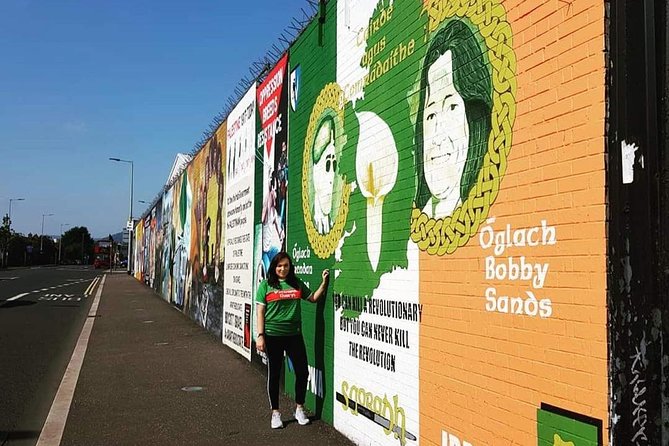
On Divis Street, the tour reaches the International Mural Wall, described as one of Western Europe’s largest outdoor galleries of political art. Here, local Republican subjects sit alongside causes from outside Northern Ireland.
The most important images include the ten hunger strikers who died in 1981, among them Bobby Sands. Your guide explains the political conflict surrounding the hunger strike and the clash with Margaret Thatcher’s government. This is one of the points where the tour moves beyond a simple explanation of who lived on which side of the wall. It deals with imprisonment, political status, protest, and the human cost of the conflict.
Other murals refer to Palestine and Israel, Nelson Mandela and the anti-apartheid movement, and George Floyd and Black Lives Matter. These additions show how Belfast’s mural tradition connects local political memory with international struggles.
This is a good place for photographs, but remember that the wall is also an argument in paint. The images are not neutral decoration. Your guide’s role is to explain the message, the people represented, and the political setting behind it.
The itinerary includes the International Mural Wall more than once, so do not be surprised if the route returns to this area or lists it under a second stop. The repeated listing reflects the importance of the wall within the tour rather than two entirely different attractions.
Seeing the Peace Wall up close
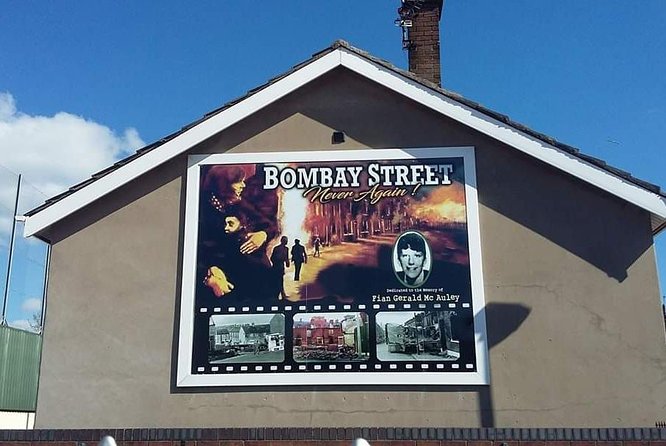
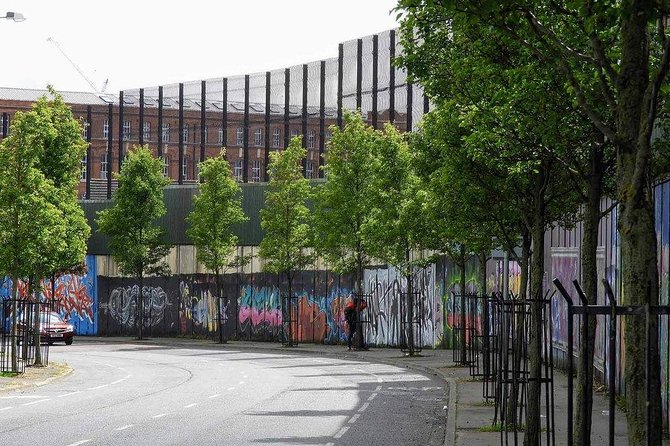
The Peace Wall is the tour’s clearest physical reminder that Belfast’s communities remain divided by more than memory. These barriers separate areas that are mainly Republican and nationalist from areas that are mainly Loyalist and unionist.
The walls can be made from iron, brick, or steel and can reach about 25 feet in height. Some have gates that permit passage during the day but close at night. The tour explains that the stated purpose is to reduce violence at areas where communities meet, though the barriers also show how separation became part of the city’s daily structure.
You visit more than one section of the wall. At one stop, the guide explains the Peace Gates and their importance. At another, you see the largest section and the signatures left by Bill Clinton and the Dalai Lama. You can add your own name or short message there, then take photographs.
That interactive detail is easy to enjoy, but it should not erase the seriousness of the place. The wall is not an old monument from a finished conflict. Its presence reflects a peace process that has reduced violence while leaving many divisions in place.
The stop is scheduled for about 10 minutes. Use that time for the explanation and photos. If writing on the wall matters to you, have your message in mind before arriving.
A completely different kind of day:
- From Belfast: Giant’s Causeway Full-Day Guided Trip
★ 4.8 · 6,361 reviews - Titanic Belfast Entrance Ticket: Titanic Visitor Experience Including SS Nomadic
★ 4.5 · 3,698 reviews - A History of Terror – Belfast City Centre Walking Tour
★ 5.0 · 2,883 reviews - Game of Thrones and Giant’s Causeway Full-Day Tour from Belfast
★ 5.0 · 2,291 reviews
Crossing to Shankill Road and Loyalist Belfast
The move from the Falls Road to Shankill Road is one of the most useful parts of the route. You are not just seeing two sets of murals. You are seeing how neighboring communities express different ideas of identity, allegiance, and history.
On the Shankill, the guide explains King Billy, the bonfires, the House of Orange, and the traditions associated with Ulster Loyalism. Flags and murals give the area a distinct political character. The tour also covers the role of Loyalist groups during the Troubles and points out images connected with the UVF and armed paramilitaries.
One mural features Stevie, known as Top Gun. The guide also discusses the Bayardo Bar Memorial, which is connected to one of the Loyalist memorial sites on the route. Pictures of the Queen appear alongside political and paramilitary references, creating a visual mix that can be difficult to interpret without local explanation.
This section is valuable because it prevents the tour from becoming a one-sided journey through Republican memory. You hear about the Loyalist position in the same direct way you hear about the Republican side. Still, the subject is painful and political. You should expect frank discussion of violence, loss, and armed organizations rather than a polished sightseeing presentation.
Memorial gardens and the names behind the murals
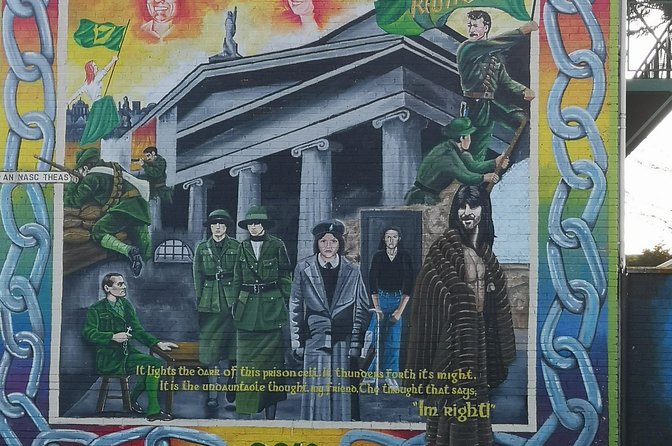
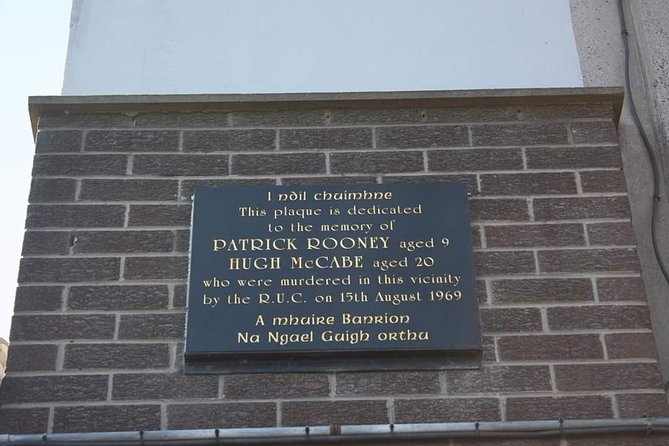
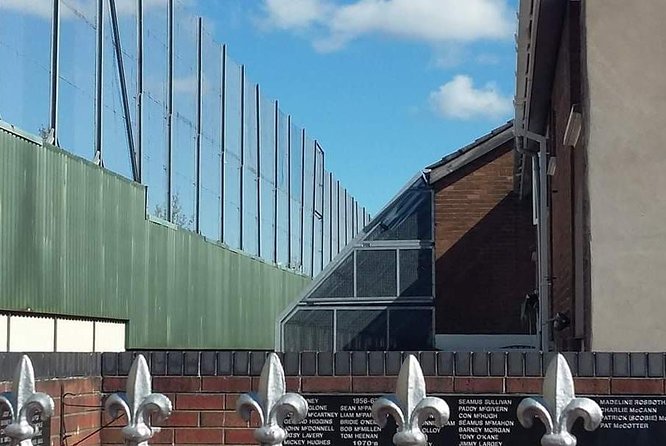
Several stops focus on memorial gardens rather than large wall paintings. At the Clonard Martyrs Memorial Garden, you see an Irish Republican memorial space. On the Falls Road, the Garden of Remembrance honors members of IRA D Company who were killed in action and includes their names.
These places reward a slower attitude, even though the scheduled stops are brief. A mural can make a strong first impression, but names on a memorial ask you to think about individual lives and how each community remembers those it lost.
The tour also visits the Shankill Road Memorial Garden at the site of the former Bayardo Bar. This gives you a Loyalist memorial space to compare with the Republican gardens. The point is not to suggest that the two traditions are identical. It is to show how both communities built public places for remembrance and political identity.
If you are interested in the personal side of the Troubles, listen closely during these stops. The photographs and videos used by the guide can help connect names and symbols with the events of the 1970s and later decades.
Bobby Sands, Sinn Féin, and the Falls Road
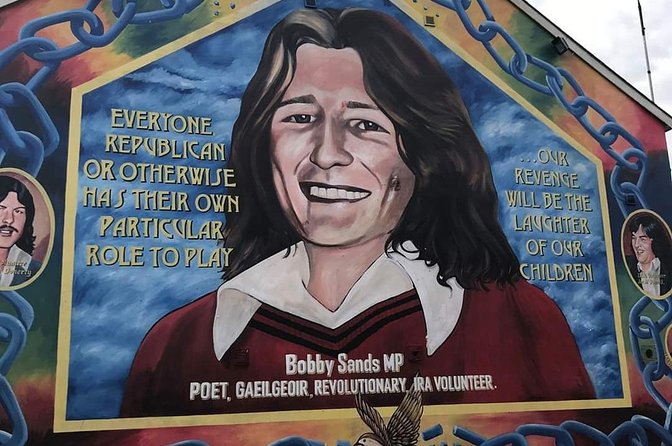
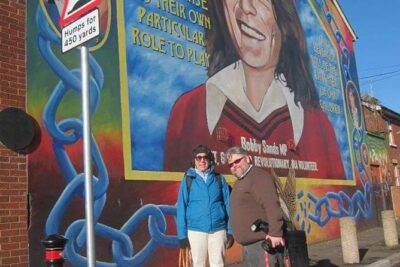
The Bobby Sands mural is one of Belfast’s best-known political images. The tour stops at the mural near the political wing of the IRA at the Sinn Féin office on the Falls Road.
Bobby Sands became an international symbol after dying during the 1981 hunger strike. The guide places the mural within the wider story of imprisonment, Republican politics, and the dispute over whether paramilitary prisoners should be treated as political prisoners.
You have about 15 minutes here, a little longer than at most other stops. That extra time helps because the mural is a major focus of Belfast’s political identity, and the surrounding area includes other images tied to the Republican cause.
The stop is likely to be most useful if you ask questions. The tour is designed as a personal explanation, and the supplied details emphasize that guides are willing to explain difficult subjects and respond to questions. Paula, in particular, receives praise for making the background clear while keeping the mood friendly and approachable.
The final mural stops on Sherbrook Close
The route ends with more memorial and mural subjects, including the Loyalist Memorial Garden and murals of armed Loyalist paramilitaries at 56 Sherbrook Close. These are not decorative street-art stops in the usual sense. They present the memory of armed conflict from within the community that created them.
At this point, the value of the tour lies in comparison. You have seen Republican murals, Loyalist murals, memorial gardens, international political art, and the physical barriers between districts. Together, these stops show why Belfast’s political art cannot be separated from local geography.
The final sections may feel repetitive if you have already seen several mural walls. That is the tradeoff for covering so much ground in a short private tour. You get a broad introduction rather than a long, quiet examination of one neighborhood.
What the guides add to the experience
The strongest part of this tour is the guide. Paula is praised for being informative, warm, and good craic, with a clear ability to explain both sides of the Troubles. That combination matters in Belfast, where a cold presentation can make the subject feel like a list of dates and factions.
Barry receives similar praise for explaining the troubled history of Northern Ireland in great breadth. One booking party also appreciated his patience when traffic caused a slightly late arrival. That suggests some practical flexibility, though you should still aim to be ready at the agreed pickup point.
The tour uses local knowledge rather than only a prepared script. You are shown the spots where events took place, then given photographs or video to help picture the earlier scene. This approach makes the tour feel connected to real streets and real communities.
The guides are not described as neutral in the sense of having no viewpoint. Any local explanation of the Troubles carries memory and identity. The useful promise here is that the tour presents both Republican and Loyalist areas and explains the role of each side.
Price, pickup, and timing
The listed price is $130.34 per person. For one or two people, that is a sizable expense for a tour lasting about 90 minutes to two hours. For a group, the private taxi and the ability to divide the cost across several people make the price easier to defend.
Free pickup and drop-off are available from central Belfast hotels and Airbnbs if requested. You must state your pickup point and preferred start time when booking. Available starts are 9 a.m., 11 a.m., 1 p.m., 3 p.m., and 5 p.m.
Cruise ship passengers pay an extra $20 each way in cash for port pickup and drop-off. Drop-off at Titanic Belfast or Crumlin Road Gaol costs an additional $10 paid directly to the guide. A Mercedes-Benz upgrade may be available for $20 more, but it is not guaranteed.
The tour is offered in English and includes a mobile ticket. Children must be accompanied by an adult, service animals are allowed, and the tour is near public transportation. Most people can take part, though the supplied details do not describe a specific wheelchair-access plan.
Free cancellation is available if you cancel at least 24 hours before the local start time. Changes or cancellations made inside that window are not accepted for a refund.
Who should book this Belfast taxi tour?
I would choose this tour if you want a clear first look at Belfast’s political murals and do not want to plan a route through West Belfast yourself. It suits adults interested in modern political history, families with older children, small groups, and anyone who values a private guide over a large coach.
It is also a good fit if you have limited time in Belfast. The taxi covers several districts and key memorials in one compact outing. The hotel pickup helps if you are staying centrally and want to begin without finding a meeting point.
I would hesitate if you want a quiet art tour, a long museum visit, or a detailed examination of every mural. The subject is serious, the schedule is brisk, and the political imagery includes hunger strikes, paramilitary groups, deaths, and community conflict.
Should you book it?
Book it if you want Belfast’s Falls Road, Shankill Road, Peace Wall, and memorial gardens explained by a local guide in one private ride. The best reason to go is not simply the black taxi. It is the chance to compare both communities and connect today’s murals with photographs and events from the Troubles.
For the strongest value, bring a group, request central pickup, and allow time for questions. If you are traveling alone or as a couple, compare the price with a shared alternative. But if Paula or Barry is available and you want a personal, balanced introduction to Belfast’s divided past, this tour has the right focus.
FAQ
How long does the Belfast Black Taxi Tour last?
The tour lasts approximately 1 hour and 30 minutes to 2 hours.
How much does the tour cost?
The listed price is $130.34 per person.
Is the tour private?
Yes. Only your group participates, with a maximum of 18 people per booking.
Is hotel pickup included?
Free pickup and drop-off are offered from central Belfast hotels and Airbnbs when requested at booking.
Is cruise port pickup included?
No. Cruise ship passengers pay an extra $20 each way in cash for pickup and drop-off from the Belfast cruise ship port.
What language is the tour offered in?
The tour is offered in English.
Can I be dropped at Titanic Belfast or Crumlin Road Gaol?
Yes. Drop-off at either location costs an extra $10, paid directly to the guide.
Can I cancel for a full refund?
Yes, if you cancel at least 24 hours before the experience start time. Cancellations or changes made less than 24 hours before the start time are not refunded or accepted.
Just added in Belfast
- Falls road Murals Walking Tour with former prisoners★ 5.0 · 19 reviews
- Private Half Day Winter Magic in the Antrim Glens★ 5.0 · 2 reviews
- Belfast’s Titanic Quarter: A Self-Guided Audio Tour★ 5.0 · 6 reviews
- The Troubles and iconic award winning taxi 2hr private cab tour★ 5.0 · 28 reviews
- Titanic Maritime Walking Tour★ 5.0 · 23 reviews
- Titanic Eastside Bike Tour★ 5.0 · 9 reviews
- The Single Cask Whiskey Experience★ 5.0 · 6 reviews
- The Giants Causeway Tour★ 5.0 · 1 review
Belfast Black Taxi Tours, compared.
World Famous Belfast City Centre Black Cab/Taxi Tour 2 Hours
Read our review →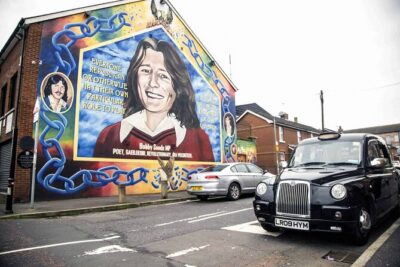
Black Taxi Tour and Crumlin Road Gaol tour Combo
Read our review →
Browse the lists this tour appears in