
Reviewed · WALKING TOURS
Best of Belfast Walking Tour
Belfast rewards a closer look. This three-hour walk links City Hall, the Cathedral Quarter, the River Lagan, Belfast Entries, and Titanic stories with a local guide who explains how the city became what it is today. I especially like the way the tour mixes famous sights with smaller details, such as Belfast’s old cobbled lanes, punk history, public art, and long-gone castle.
The headsets are another smart touch, especially on busy streets or beside the river. I also like the easy pace and the mid-tour coffee and restroom break mentioned by several participants. The main consideration is simple: this is a full three hours on foot, and the history of Belfast can be difficult and politically charged. It suits curious visitors, but not anyone seeking a light sightseeing stroll.
In This Review
- Key points to know before you book
- Why this is a useful first morning in Belfast
- Starting at Belfast City Hall
- St. Mary’s, Bank Square, and the Belfast that disappeared
- St. Anne’s Cathedral and the United Irishmen
- Hill Street, street art, and Belfast’s punk story
- Customs House and Speaker’s Corner
- The River Lagan, Big Fish, and Titanic’s yellow cranes
- Belfast’s leaning clock and a local pub recommendation
- The Belfast Entries, an outdoor art gallery
- Spirit of Belfast and the city center today
- Titanic Memorial Garden and the return to City Hall
- The guides and the style of storytelling
- Pace, comfort, and practical planning
- Who should book the Best of Belfast Walking Tour?
- Should you book it?
- FAQ
- Where does the Best of Belfast Walking Tour start?
- What time does the tour begin?
- How long does the walking tour last?
- Does the tour return to Belfast City Hall?
- Are headsets provided?
- What happens if the weather is poor?
Key points to know before you book
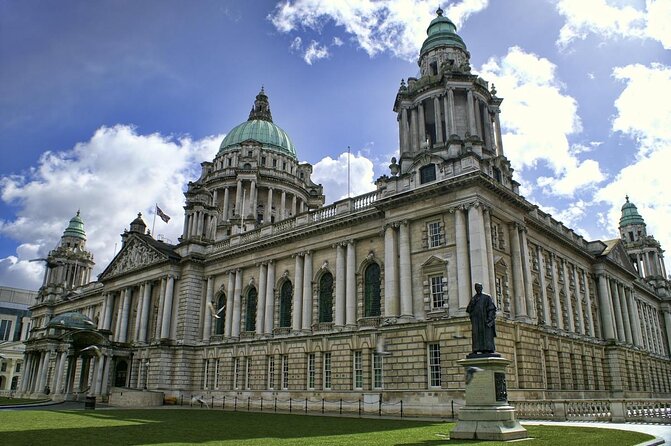
- City Hall is the starting point: Meet at the front gates at 10:00 a.m., then begin with a short introduction to Belfast.
- The tour covers ten central stops: You see major buildings, public sculptures, old lanes, the Cathedral Quarter, and the Titanic Memorial Garden.
- The Troubles receive serious attention: The guides connect Belfast’s recent past with politics, culture, music, and daily life.
- Headsets make a real difference: You can hear the guide while walking outdoors instead of gathering tightly around every stop.
- Expect an easy but substantial walk: The pace is moderate, but the route is not ideal for people with mobility issues.
- Local advice is part of the value: Guides such as Mark, Colin, Paul, Jim, Chris, Steve, and James have offered tips on bars, restaurants, nightspots, directions, and things to do afterward.
Why this is a useful first morning in Belfast
Belfast is compact enough to explore on foot, but its story is not simple. Shipbuilding, religion, industry, political conflict, music, public art, and recent regeneration all sit close together. A good walking tour helps you connect those pieces instead of treating each building as an isolated photo stop.
This route works well early in a visit because it gives you a working map of the city center. You begin and end at Belfast City Hall, so you can return later to places that caught your interest. You also get practical suggestions for eating and going out, which can save you from choosing a restaurant at random after a long day.
The experience costs $36.05 per person. That is fair value for roughly three hours with a licensed local guide, provided you want context rather than only landmarks. You are not paying admission fees along the route, since the listed stops are viewed from outside or explored as public spaces. The real product is the guide’s storytelling and the connections between the sites.
The tour is often booked well in advance, with an average booking time of 33 days. If your dates are fixed, I would not leave it until the last morning, especially during a busy travel period.
More walking tours in Belfast:
- A History of Terror – Belfast City Centre Walking Tour
★ 5.0 · 2,883 reviews - Belfast Political Tour-Conflicting Stories Walking Tour
★ 4.5 · 459 reviews - Belfast Eclectic Walking City Center Experience, The Marti Way
★ 5.0 · 348 reviews
Starting at Belfast City Hall
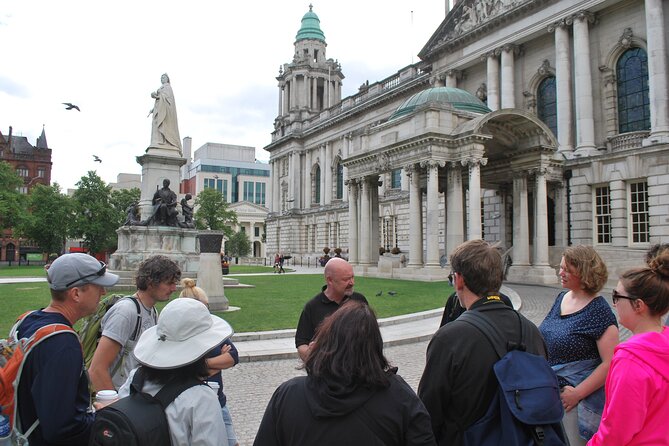
The walk begins at the front gates of Belfast City Hall in Donegall Square North. The first 15 minutes set up the city’s story and give you a sense of how the center is arranged.
City Hall is a useful opening point because it is both a grand civic building and a place tied to Belfast’s public life. You will not pay an admission fee on this tour, and the focus is on the building, the square, and the wider story of the city.
A good guide should make this first stop more than a quick photograph. Mark, Paul, Steve, and several other guides are praised for explaining facts in a relaxed, story-led way. That style matters here. Belfast’s past includes plenty of dates and political terms, but stories help you remember what you are seeing.
St. Mary’s, Bank Square, and the Belfast that disappeared
The short stop at St. Mary’s Roman Catholic Church adds an important layer to the tour. In Bank Square, you hear about the church, its unusual grotto, and the original Belfast Castle that once stood nearby.
This is the sort of detail that a self-guided walk can easily miss. Belfast’s present streets do not always reveal what occupied the same ground centuries ago. The lost castle gives you a glimpse of an older city, while St. Mary’s helps explain the religious and social fabric of the center.
The stop lasts about ten minutes, so expect a concise explanation rather than a full church visit. That is a useful rhythm for a walking tour. You get enough background to understand the place, then keep moving before the route becomes a series of long lectures.
St. Anne’s Cathedral and the United Irishmen
The route continues into the Cathedral Quarter and to Belfast Cathedral, also called the Cathedral Church of St. Anne. The visit lasts about 15 minutes and introduces the area’s religious, civic, and political past.
Here, the guide discusses the United Irishmen and their part in the city’s development. This is one of the points where Belfast’s story reaches beyond the familiar Titanic narrative. You begin to see how ideas about identity, government, and Ireland shaped the city long before the modern period.
The Cathedral Quarter is also one of Belfast’s most useful areas for returning later. The tour gives you a first look, then adds recommendations for bars, restaurants, and nightspots. You may want to note those suggestions rather than trying to remember everything while walking.
A completely different kind of day:
- From Belfast: Giant’s Causeway Full-Day Guided Trip
★ 4.8 · 6,361 reviews - Titanic Belfast Entrance Ticket: Titanic Visitor Experience Including SS Nomadic
★ 4.5 · 3,698 reviews - Cab Tours Belfast Famous Black Taxi Tours
★ 5.0 · 3,633 reviews - Game of Thrones and Giant’s Causeway Full-Day Tour from Belfast
★ 5.0 · 2,291 reviews
Hill Street, street art, and Belfast’s punk story
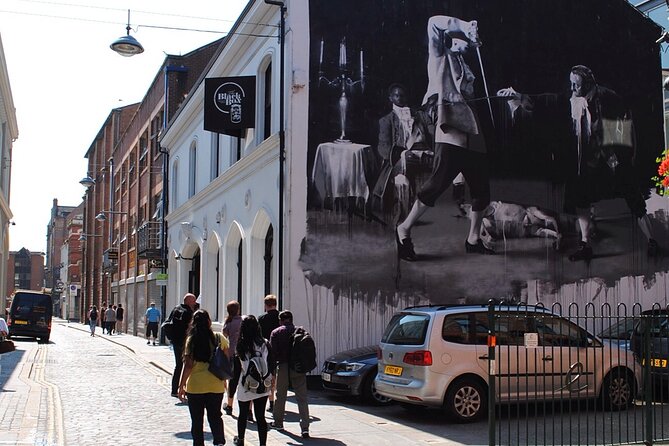
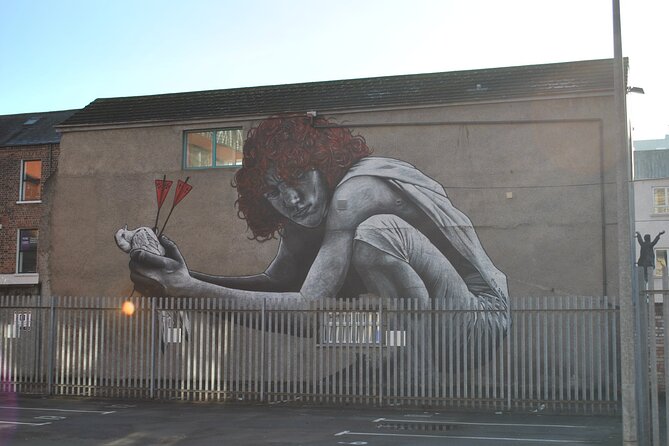
One of the most enjoyable parts of the route is Hill Street, one of Belfast’s remaining cobbled streets. It sits in the Cathedral Quarter and offers a change from the broad civic spaces around City Hall.
The guide points out street art and explains some of the stories behind it. Public art can be a quick visual stop, but the best explanations connect it to the people and events around it. This route also brings in the story of punk in Belfast and its importance during The Troubles.
That subject gives the walk a human scale. Instead of discussing the conflict only through politics and violence, the guide shows how music and nightlife created forms of expression and community. The account can be entertaining, but it is not a cheerful history lesson from start to finish. You should expect difficult subjects and allow the guide to explain them with care.
The 15-minute timing here is enough for an overview. If street art is a major interest, you may want to return to the area later and explore at your own speed.
Customs House and Speaker’s Corner
At Customs House, the focus shifts to one of Belfast’s finest historic buildings and the public life that surrounded it. This was the site of Speaker’s Corner, where orators addressed the public.
The guide shares stories about some of the best and worst speakers who appeared there, along with the history of one of Belfast’s oldest surviving pubs nearby. These details keep the stop lively and show how public debate, drinking culture, and city life overlapped.
At ten minutes, this is another brief but worthwhile pause. You are not getting a formal architectural tour of Customs House. Instead, you are learning how the building functioned within Belfast’s social life. That approach is one of the tour’s strengths: buildings become settings for people and stories.
The River Lagan, Big Fish, and Titanic’s yellow cranes
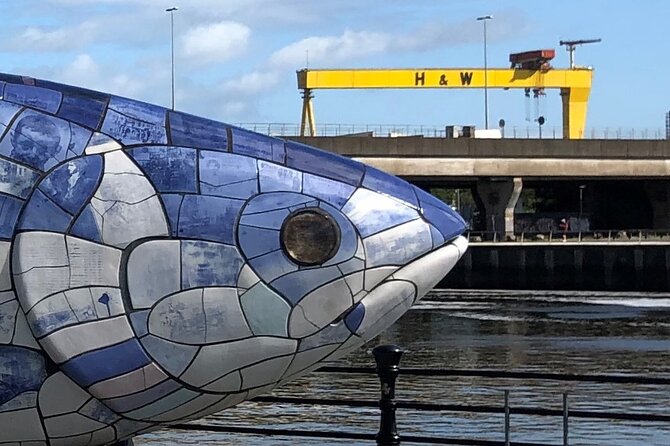
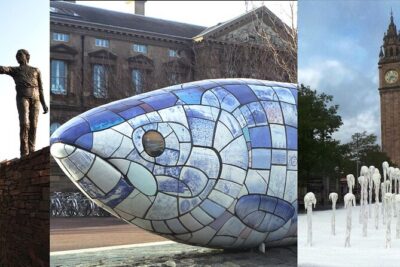
Walking along the River Lagan brings you to the Big Fish, one of Belfast’s best-known public sculptures. The guide explains the legend behind the Salmon of Knowledge and points out the yellow cranes of Harland & Wolff across the river.
Those cranes connect the modern city to Belfast’s shipbuilding past. The Titanic was built here more than a century ago, and the view gives that story a clear physical setting. You are not just hearing about a ship in a museum. You are looking toward the industrial area where Belfast’s shipyards shaped its name and economy.
The route also includes the Beacon of Hope, described as a symbol of Belfast’s resilience and recent regeneration. The contrast between the shipyards, the riverfront, and the newer public art gives you a quick sense of how the city has changed.
This section may be especially good for photographs, though your attention will still be on the guide. The headsets are useful beside open water and along wider streets, where voices can otherwise get lost.
Belfast’s leaning clock and a local pub recommendation
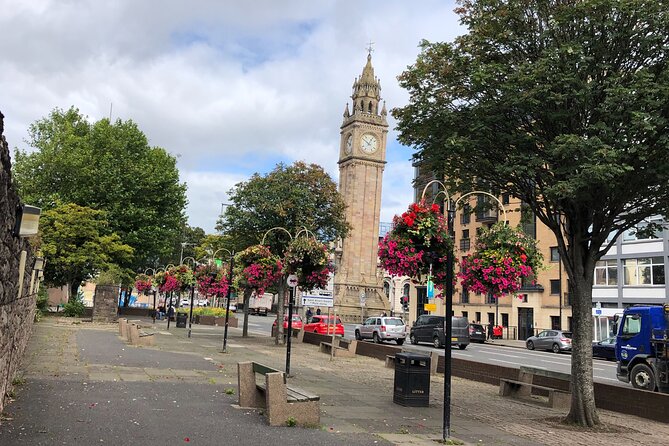
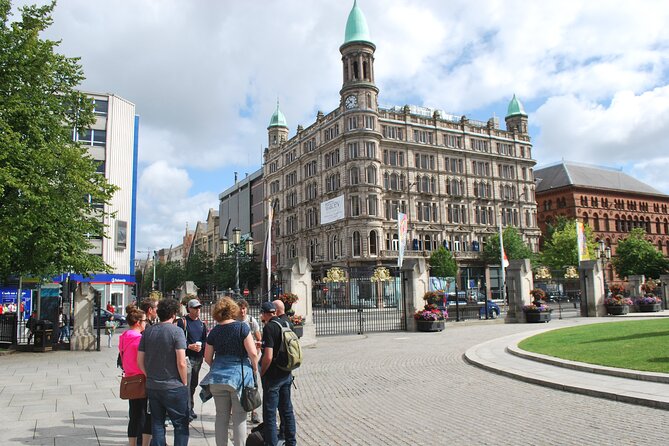
The Albert Memorial Clock is Belfast’s answer to a leaning tower. During the 15-minute stop, you learn why the clock tilts and hear an explanation of how Belfast got its name.
The clock is an easy landmark to appreciate once you know its problem. Without that context, you might simply notice that it leans and move on. The guide also points out a favorite pub associated with Belfast’s most famous footballer, adding a small piece of local sporting culture to the route.
This stop shows the tour’s broad range. In a few minutes, the subject shifts from Victorian engineering to place names and football. You will not become an expert in any one topic, but you will collect enough small stories to make the city more memorable.
The Belfast Entries, an outdoor art gallery
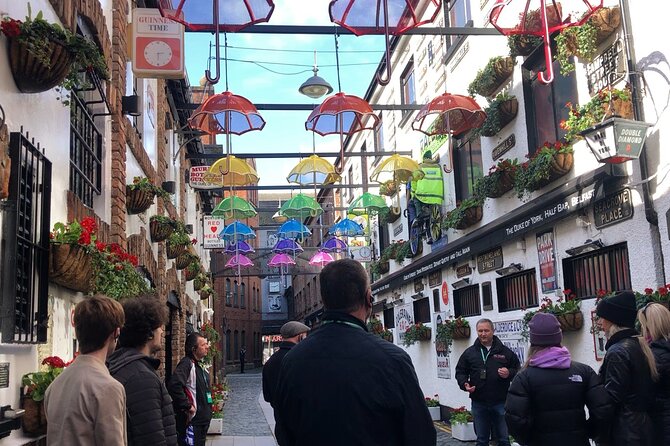
The Belfast Entries are among the most atmospheric parts of the walk. These narrow passages lie in the oldest part of the city and have been turned into an outdoor gallery filled with murals and other artwork.
The route allows about 15 minutes here. You hear why the area mattered and learn about the people who lived and worked there over the centuries. The art gives you something immediate to look at, while the guide supplies the older social history behind the lanes.
I like this pairing of visual detail and local history. Belfast’s oldest areas are not always grand or polished, but they often say more about ordinary city life than a formal monument does. Keep your eyes open and your pace steady, since there can be many pieces competing for your attention.
Spirit of Belfast and the city center today
The Spirit of Belfast sculpture sits in a pedestrian area at the heart of the city. The guide explains its meaning, its alternative name, and the older buildings around it.
This is a short stop, but it helps you read Belfast’s public art with more care. Some sculptures are playful or odd at first glance. Knowing what they represent, and what locals call them, gives them a place in the city rather than leaving them as random objects in a shopping district.
The surrounding pedestrian precinct also shows Belfast as it functions now. After hearing about conflict, industry, and older city life, you see the ordinary modern center: people moving between shops, offices, cafes, and public spaces.
Titanic Memorial Garden and the return to City Hall
The final stop is the Titanic Memorial Garden in the grounds of City Hall. The tour returns to its starting point after about 15 minutes here.
You hear the story of the most famous ship built in Belfast and some of the people who sailed on it. The guide also discusses notable citizens represented by statues around City Hall and their contributions to society.
Ending here is sensible. Titanic is a major part of Belfast’s identity, but it is presented after you have learned about the city’s churches, public buildings, working areas, art, politics, and culture. That gives the shipbuilding story more meaning and prevents the whole walk from becoming a single-theme Titanic tour.
If you plan to visit the Titanic Belfast museum separately, this stop works as background rather than a replacement. The walking tour provides a city context. It does not offer an indoor museum visit or a detailed exhibition.
The guides and the style of storytelling
The strongest part of this experience is the guide. Mark is praised for combining hundreds of years of information with useful recommendations and a relaxed manner. Colin is described as both fun and well versed in Belfast, Northern Ireland, Ireland, and the United Kingdom. Paul receives particular credit for passion, humor, and making complex history connect with current events.
Jim is noted for a moderate pace and clear historical explanations. Chris is praised for checking that everyone was comfortable and for giving useful help after the tour. Steve is known for local history, culture, and practical suggestions, while James brings the perspective of someone born and raised in Belfast.
The exact guide affects the tone, of course. Still, the repeated pattern is clear: the experience depends on personable local storytelling rather than a memorized list of dates. Headsets support that style because you can keep walking without missing the next point.
One fair caution is that Belfast’s political history requires careful explanation. A three-hour tour can only cover the causes and consequences at a broad level. If you want a detailed study of The Troubles, this should be a starting point, not your only source. Pay attention, ask questions, and treat the tour as an introduction to a complicated subject.
Pace, comfort, and practical planning
The walk is described as moderate rather than strenuous, but it is still close to three hours. Wear comfortable shoes, arrive on time, and be prepared to remain on your feet for much of the morning.
A coffee and restroom break is included around the halfway point according to the tour experience described by participants. That pause gives you time to sit, ask questions, and catch up with the group. It also makes the three-hour format easier to manage.
Headsets are provided and are one of the most practical features. You should be able to hear the guide clearly while moving between stops, which is especially helpful in open streets or larger public spaces.
The group can have up to 25 people. That is not a private tour, but it is small enough to remain manageable if everyone stays together. The tour is offered in English, uses a mobile ticket, and begins at 10:00 a.m. at Belfast City Hall.
Most people can take part, and service animals are allowed. The route is not suitable for everyone with mobility issues, so consider the amount of walking before booking. It operates in all weather conditions, and poor weather may lead to a different date or a full refund. Dress for rain and wind rather than trusting a bright morning forecast.
Who should book the Best of Belfast Walking Tour?
I would choose this tour if you are new to Belfast and want a clear first look at the city center. It is also a good fit if you want more than architecture, since the route includes music, sport, public art, religion, politics, shipbuilding, and local recommendations.
It suits independent visitors who like to keep exploring after a guided introduction. The tour ends where it starts, and several guides offer directions and suggestions for the rest of the day.
You may want a different experience if you dislike long walks, have limited mobility, or prefer a tightly focused subject. This is not only a Titanic tour, not only a Troubles tour, and not only a pub walk. Its value comes from bringing many parts of Belfast together in one morning.
Should you book it?
Book it if you want a well-paced orientation with serious local context. At $36.05, the price is reasonable for three hours of guiding, especially with headsets and a mid-tour break included.
I would book in advance if your schedule is fixed, wear supportive shoes, and leave room afterward to revisit the Cathedral Quarter, explore the Belfast Entries, or visit a Titanic attraction. The Best of Belfast Walking Tour will not answer every question about Northern Ireland, but it should help you ask better ones and see the city with more understanding.
FAQ
Where does the Best of Belfast Walking Tour start?
The tour starts at the front gates of Belfast City Hall, Donegall Square North, Belfast BT1 5GS, United Kingdom.
What time does the tour begin?
The stated start time is 10:00 a.m.
How long does the walking tour last?
The tour lasts approximately three hours.
Does the tour return to Belfast City Hall?
Yes. The tour ends back at the meeting point, at the Titanic Memorial Garden near City Hall.
Are headsets provided?
Yes. Headsets are included so you can hear the guide more easily outdoors.
What happens if the weather is poor?
The tour operates in all weather conditions, so you should dress appropriately. If it is canceled because of poor weather, you will be offered another date or a full refund.
Just added in Belfast
- Falls road Murals Walking Tour with former prisoners★ 5.0 · 19 reviews
- Private Half Day Winter Magic in the Antrim Glens★ 5.0 · 2 reviews
- Belfast’s Titanic Quarter: A Self-Guided Audio Tour★ 5.0 · 6 reviews
- The Troubles and iconic award winning taxi 2hr private cab tour★ 5.0 · 28 reviews
- Titanic Eastside Bike Tour★ 5.0 · 9 reviews
- The Single Cask Whiskey Experience★ 5.0 · 6 reviews
- Titanic Maritime Walking Tour★ 5.0 · 23 reviews
- The Giants Causeway Tour★ 5.0 · 1 review
Walking Tours, compared.
Belfast Eclectic Walking City Center Experience, The Marti Way
Read our review →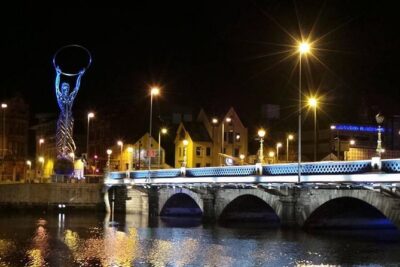
The Real Eclectic Belfast City Walking Tour/Experience.
Read our review →
The Real Story of Belfast walking tour with a local guide
Read our review →
Belfast Line of Duty Walking Tour with Private Guide
Read our review →
1/2 Day Pilgrim’s Walk on St Patrick’s Way and Lunch
Read our review →
Adult Foraging Walk & Bushcraft Cookery Course for Beginners
Read our review →Browse the lists this tour appears in